Blog · October 31, 2026 · 5 min read
New pool plaster startup: the first 28 days
A new pool plaster startup is a 28 day routine: fill without stopping, brush at least twice a day until the plaster dust is gone, and test the water on a schedule. The plastering trade treats that first month as the time a finish is most prone to staining, scaling and discoloration. The routine is the same every time, and each step has a reason. Here are the fill, the brushing, the chemistry, what to leave alone and why color problems show up.
Plaster
What happens in a new pool plaster startup?
A startup is the 28 day care routine that begins when the pool is filled after a resurface. Cement based finishes start to hydrate right after mixing, and most of that happens in the first 28 days, according to the pool plastering trade's start-up guidelines.
That is why the guidelines call timely brushing and constant water monitoring mandatory. They run day by day from fill day to day 28, with tests, brushing and chemical changes set for each stage.
Chlorine, for example, goes in on day 3, not on fill day. Any cement based finish follows a start-up like this, plaster, quartz and pebble style finishes included.
Plaster
How do you fill a pool after new plaster?
Fill without stopping. The start-up guidelines say to fill to the middle of the skimmer as rapidly as possible and without interruption, using clean potable water, to help prevent a bowl ring.
A finish maker's data sheet says the same: fill immediately and keep filling until the finish is completely submerged. The guidelines also have the fill water tested for pH, alkalinity, calcium hardness and metals before anything goes in, and they keep people and pets out of the pool during the fill.
They add that parts of the procedure may need to change for local water conditions. Scottsdale water runs 13 to 17 grains per gallon of hardness depending on the zone (City of Scottsdale 2026 Water Quality Report (opens in a new tab)).
Plaster
How often should new plaster be brushed?
At least twice a day until all the plaster dust is gone, according to the start-up guidelines and a 2024 pool industry start-up guide. If dust is still there on day 7, both say it comes out with a pool brush vacuum.
After that, the 2024 guide has brushing as needed through day 28. The pump matters as much as the brush: filtration runs continuously for at least the first 72 hours in both sources.
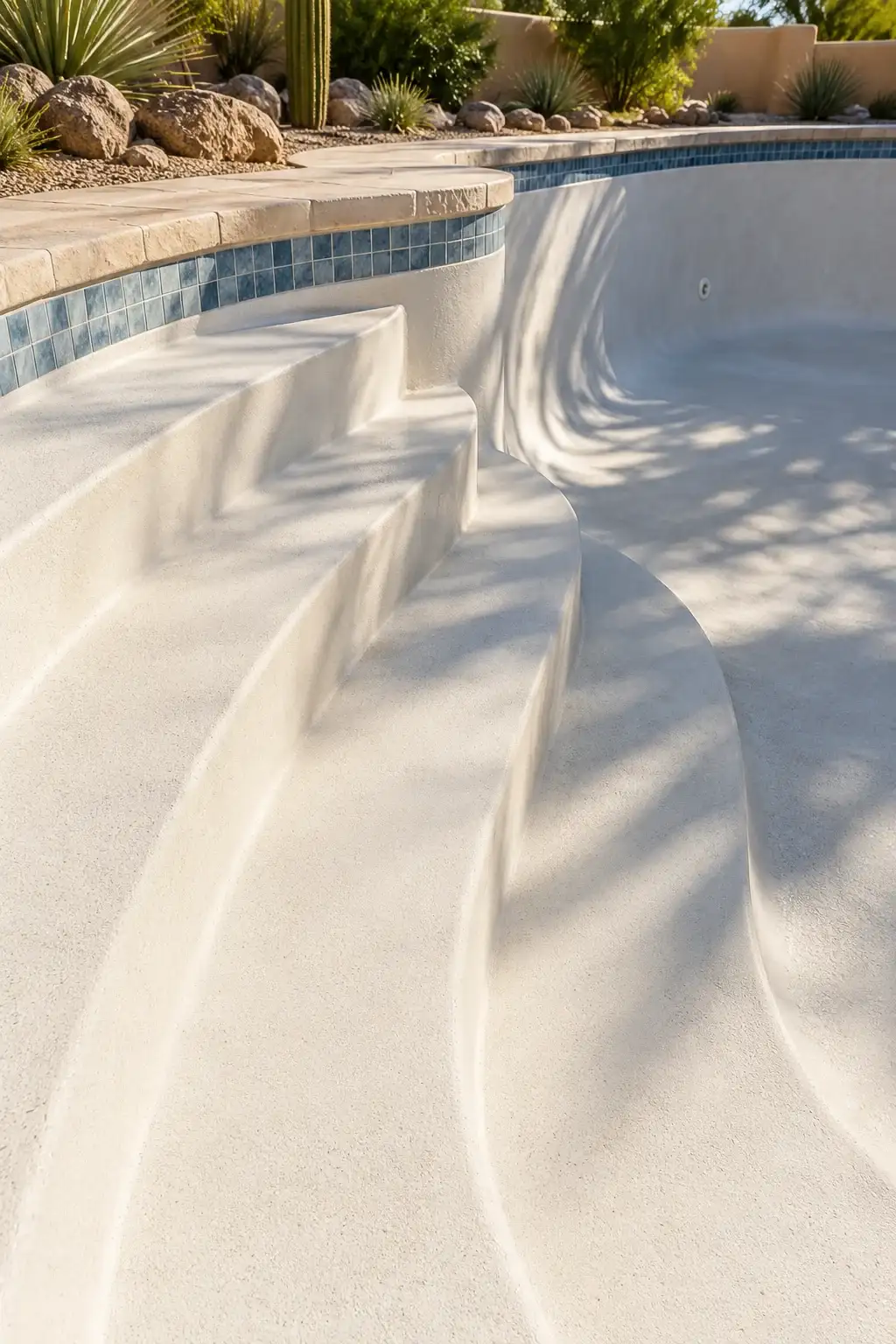
Plaster dust is the white residue that shows after filling. A finish maker's data sheet says calcium chloride in the mix can increase it.
Plaster
What water chemistry does new plaster need?
Start with the public health baseline: the CDC recommends pH 7.0 to 7.8 and free chlorine of at least 1 ppm in a pool, or at least 2 ppm when cyanuric acid is used (CDC, home pool water treatment and testing (opens in a new tab)).
It says to test chlorine and pH at least twice a day, and that a DPD test kit is more accurate than strips. The plaster start-up adds its own timetable on top: it holds chlorine back until day 3 and brings calcium, alkalinity and stabilizer into range in steps, and the day by day targets sit on the trade's start-up card.
Calcium gets special attention for a reason. San Bernardino County, California, says pool water seeks calcium from any available source when the level is too low, and that the easiest source is usually the plaster coat. It calls failing to maintain proper calcium levels the leading cause of plaster failure and premature resurfacing (San Bernardino County (opens in a new tab)).
Good to know
What should you not do in the first 28 days?
Do not skip a brush, stop the fill or add salt early. The start-up guidelines and a 2024 industry start-up guide give these rules for the first 28 days:
- Do not stop the fill once it starts.
- Do not let anyone swim until the water is properly balanced.
- Do not add chlorine in the first 48 hours.
- Do not add salt for 28 days.
- Do not turn on the heater until all plaster dust is gone.
- Do not run wheeled cleaners until the 28 days are done.
Each rule protects a surface that is still hydrating.
Signs
Why does new plaster get mottled, discolored or cracked?
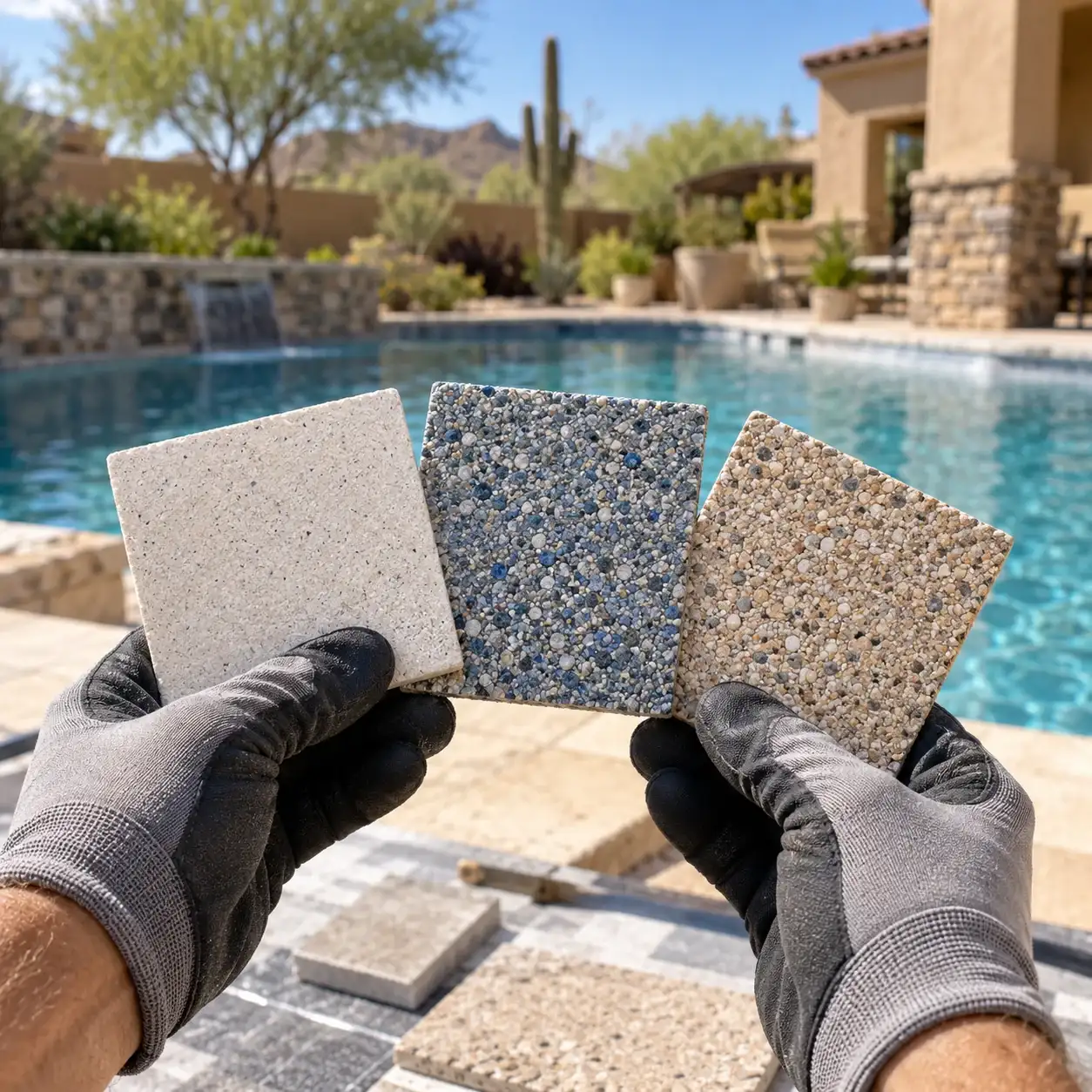
Several things act on color, and the start-up is one of them. A finish maker's data sheet says color uniformity depends on the mix batches, the equipment, the application and finishing, the start-up, the cure of the cement binder and the water chemistry after it.
The same sheet says calcium chloride in the mix can darken light finishes and make dark ones blotchy or mottled. Scaling is part of curing: one finish maker's application sheet calls it a normal phase of hydration that a proper start-up of chemical balance and brushing keeps under control, and says the initial cure usually stops after 28 to 60 days.
Fine hairline cracking, called crazing, is tied on that sheet to material that dried too fast when it was applied, which happens before the pool is filled. Marks that show up later are covered in pool plaster stains.
4 questions
Questions people ask
Still have a question? Call (747) 243-2089 and say what your pool is doing.
How long does a new pool plaster startup take?
The start-up window is 28 days, according to the pool plastering trade's guidelines. A finish maker's application sheet says the initial curing usually stops after 28 to 60 days. Brushing and water testing stay on schedule through the whole window.
Why is there white dust on new pool plaster?
Plaster dust is a white residue that shows after the pool is filled, and brushing removes it. A finish maker's data sheet says calcium chloride in the mix can increase it. The start-up guidelines call for brushing at least twice a day until it is gone.
When can you swim in a new plaster pool?
Swimming waits until the water is properly balanced, according to the trade's start-up guidelines. People and pets stay out during the fill. The date depends on the finish and the water test, so tell us about your pool and we go over the schedule with you.
Does Scottsdale hard water change a plaster startup?
The guidelines say parts of the procedure may need to change for local water conditions, and the city's water runs 13 to 17 grains per gallon. That is why the fill water gets tested before any chemical goes in.
Keep reading
- Pool replastering: for the plaster resurface that starts the 28 days.
- Quartz pool finish: for the finish that follows the same kind of start-up.
- Pool resurfacing guide: for where the start-up sits in the full job.
- Pool resurfacing cost: for the price ranges by size and finish.
- Pool resurfacing cost calculator: for a range from your own pool size.