Blog · November 3, 2026 · 4 min read
Calcium buildup on pool tile: why Scottsdale pools get it
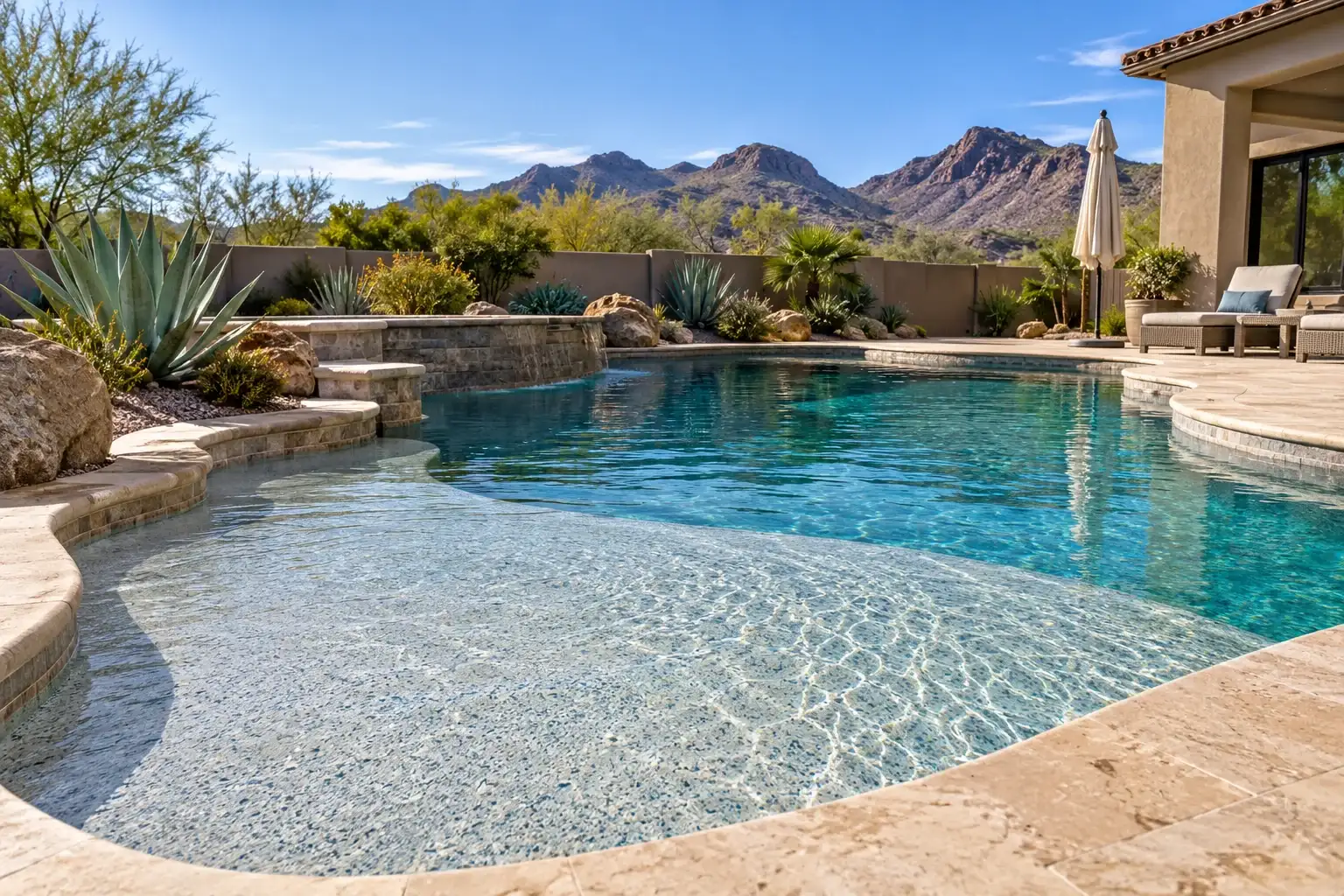
Calcium buildup on pool tile is white mineral scale left at the waterline as hard water evaporates. Scottsdale tap water runs 13 to 17 grains per gallon of hardness, and summer heat speeds the evaporation. Light scale cleans off, and scale that keeps returning points to the water. A white line on the tile is common in hard water areas and does not by itself mean the whole pool needs work. Here is what causes it, what keeps it from coming back and when new tile is the better call.
Tile and coping
What causes calcium buildup on pool tile?
Calcium comes out of the water and stays on a surface. A state health department guide says water that is too hard deposits scale on surfaces and inside equipment, and that a pH above 7.8 makes calcium come out of solution as white scale (Arkansas Department of Health (opens in a new tab)).
San Bernardino County, California, describes scale as white deposits of calcium on pool surfaces and ties it to high pH or calcium hardness that is out of range (San Bernardino County (opens in a new tab)). Evaporation adds to it: the Arkansas guide says dissolved solids rise as water evaporates because the dissolved substances remain behind. At the tile line, the water leaves and the minerals stay.
Los Angeles County Public Health adds that water with a saturation index above +0.5 can form calcium deposits that clog pipes and filter grids and can stain pool plaster, so tile is not the only place scale can show up (Los Angeles County Public Health (opens in a new tab)).
Tile and coping
Why does Scottsdale water leave so much calcium buildup on pool tile?
Because the tap water is hard, and every refill adds more of it. The City of Scottsdale 2026 Water Quality Report lists hardness at 13 to 17 grains per gallon depending on the zone, which is 215 to 290 mg/L (City of Scottsdale 2026 Water Quality Report (opens in a new tab)).
The same report lists calcium from 61.9 to 81.3 ppm and total dissolved solids from 325 to 710 ppm in 2025 testing. The USGS defines hardness as dissolved calcium and magnesium and rates water above 180 mg/L as very hard, so Scottsdale's range sits in the top band (USGS, hardness of water (opens in a new tab)).
Costs
How much does Arizona heat speed up calcium buildup on pool tile?
Heat speeds evaporation, and evaporation is what leaves the minerals. The City of Scottsdale estimates that a 400 square foot pool loses about 19,665 gallons a year to evaporation (City of Scottsdale, Water Conservation for Homeowners (opens in a new tab)).
Its monthly table runs from 2.4 inches in December to 10.8 inches in June, before any rain, and rates vary with sunlight, air and water temperature, wind, humidity and shading. Phoenix averages 111 days a year at 100 F or higher in the 1991 to 2020 normals (NWS Phoenix, extreme heat (opens in a new tab)). A pool cover is one of the city's water saving tips because it cuts evaporation.
Tile and coping
How is calcium buildup on pool tile removed?
In general terms, scale is cleaned off the tile with a product made for pools. The Arkansas Department of Health guide lists tile and surface cleaners for removing scale, scum and stains, says to use pool-specific products, and says never to use household cleaners in pool water.
Cleaning treats the scale, not the cause. Thick scale that normal cleaning does not move is a different case, and it is the point where tile replacement enters the picture, covered at the end.
Tile and coping
How do you keep calcium buildup on pool tile from coming back?
Keep the pH in range and test the calcium hardness. The CDC recommends pH 7.0 to 7.8 for a pool (CDC, home pool water treatment and testing (opens in a new tab)), and San Bernardino County says maintaining proper pH and total alkalinity helps prevent scale.
Dilute when the numbers climb. San Bernardino County and Los Angeles County both say high hardness is lowered by partially draining the pool and refilling with fresh water, and the Arkansas guide lists a partial drain and refill for scaling on walls. Scottsdale fill water is hard too, so a refill adds minerals as well as diluting them, and draining a pool in Scottsdale covers where the drained water can go.
Cut the evaporation. A cover reduces it, according to the city, and less evaporation leaves fewer minerals behind.
Tile and coping
When does scaled tile mean it is time for new waterline tile?
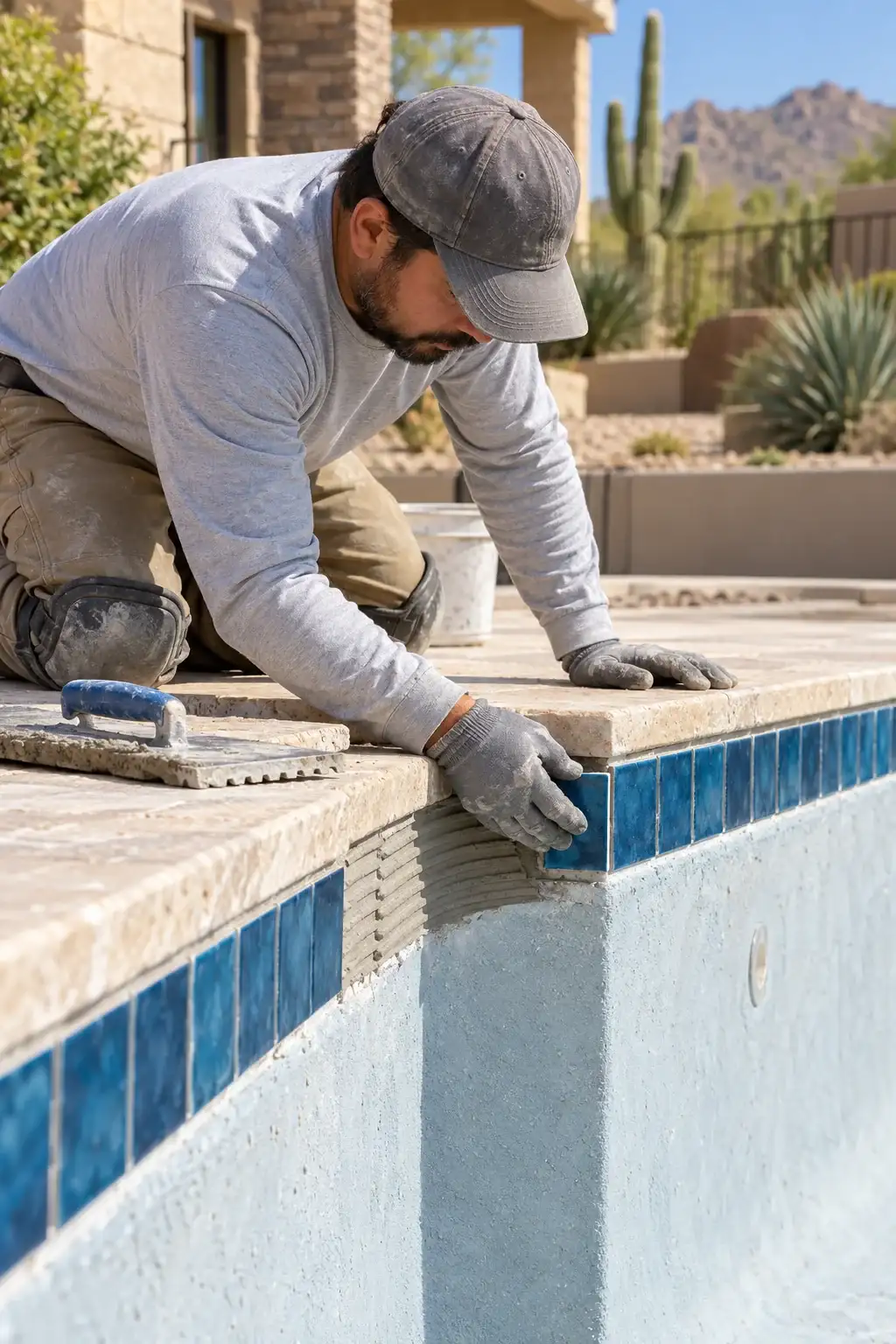
When the scale will not come off with normal cleaning, or the tile is also chipped, loose or missing pieces. Waterline tile often looks worse than the rest of the pool because it sits where the water evaporates.
A tile only job can make sense while the finish still has years left, and that is what a pool tile replacement job covers. If a resurface is already planned, the pool is being drained anyway, so the tile can be done in the same drain.
Pool tile material runs from $1 to $35 per square foot depending on the tile, according to published 2026 cost data for the Phoenix metro. Pool remodeling covers tile, coping and finish in one drain, and new tile meets the same water, so the balance steps above still apply after it goes in.
4 questions
Questions people ask
Still have a question? Call (747) 243-2089 and say what your pool is doing.
Can calcium buildup on pool tile be prevented in Arizona?
It can be slowed, not ruled out. Keeping pH in the CDC's 7.0 to 7.8 range, testing calcium hardness and partially draining when it runs high all cut scale, and a cover cuts evaporation. Scottsdale's hard fill water keeps adding minerals.
Does calcium buildup only affect the tile?
Scale also forms on other surfaces and inside equipment, according to the Arkansas Department of Health. Los Angeles County Public Health says out-of-balance water can clog pipes and filter grids and stain plaster. The tile line is just where it shows first.
Can household cleaners remove calcium buildup from pool tile?
The Arkansas Department of Health guide lists pool-specific tile cleaners for scale and says never to use household cleaners in pool water. Heavy scale that cleaners do not move is a project question, covered under new tile.
Will new tile get calcium buildup again?
It can, because scale comes from the water, not the tile. The Arkansas guide says water that is too hard deposits scale on surfaces, so the water balance matters after replacement too. The pool tile replacement page covers the job itself.
Keep reading
- Pool tile replacement: for new waterline tile on its own.
- Pool remodeling: for tile, coping and finish in one drain.
- Pool resurfacing guide: for how tile fits the full job.
- Pool resurfacing cost: for the price ranges by size and finish.
- Draining a pool in Scottsdale: for where the water goes in a partial drain.