Blog · November 7, 2026 · 6 min read
Best Dark Pool Finish Colors for a Scottsdale Pool: How Each Looks, Heats and Fades
A dark finish in Scottsdale is a choice about contrast, not about how dramatic a colour chip looks. Black, midnight blue, charcoal, slate, deep green and taupe each read differently in water, heat differently, and show the city's water differently. That last part decides which one still looks right in year three. Call (747) 243-2089 or tell us the look you want and which band of Scottsdale the pool sits in, and we call you back to narrow the colour against the water you actually have.
Good to know
How these six are ranked
They are ranked by how well each one hides the two things Scottsdale water does to a finish, mineral film and shade variation, and only then by how dark it looks. That order is the opposite of how a colour card reads, which is why a pool chosen from photographs so often disappoints. The darkest tones sit lower here than on a showroom wall, because on black every white mark has maximum contrast.
Timing
The six tones, one at a time
Black and onyx
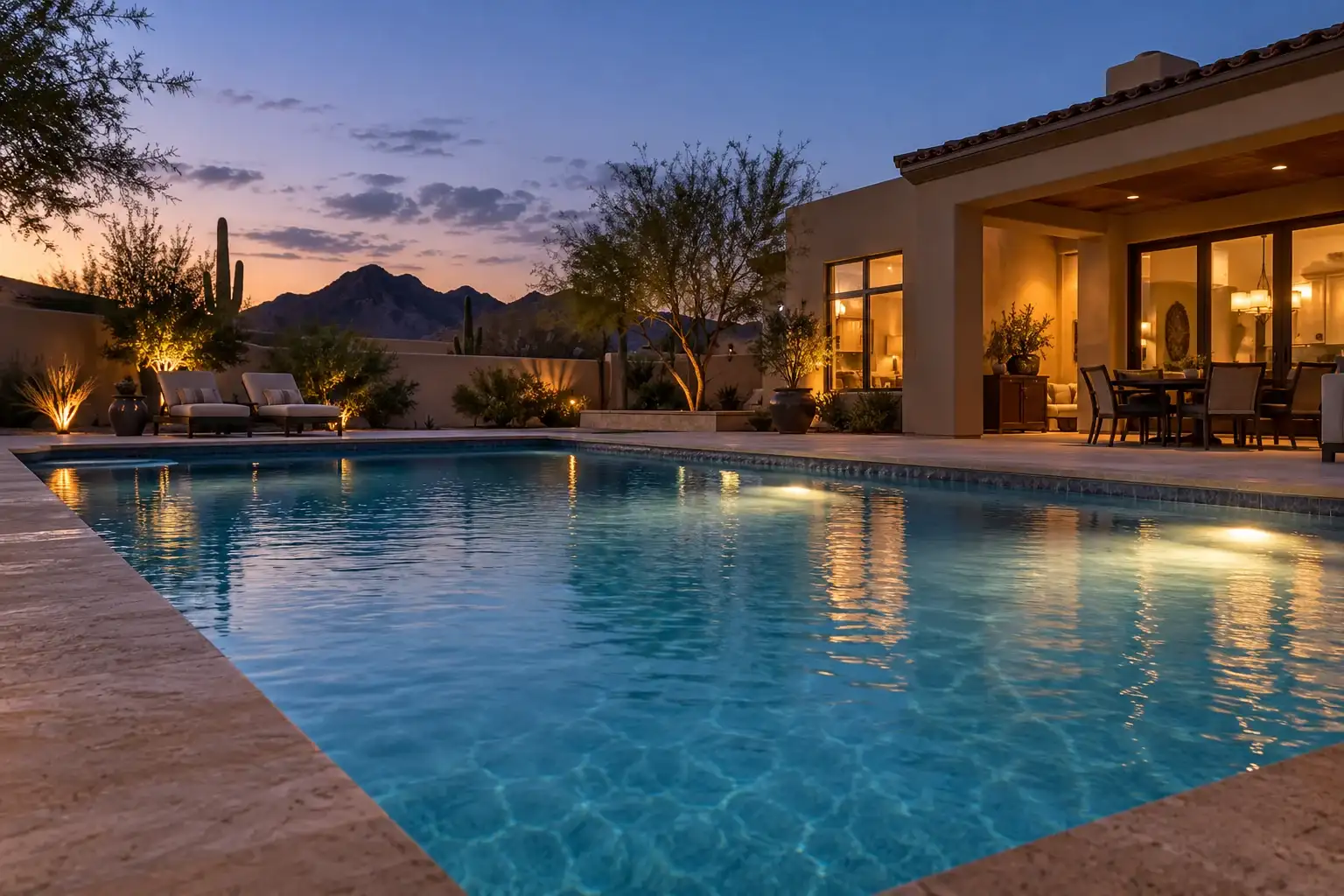
Black is the most saturated result a pool can give: the water reads almost opaque, the surface disappears, and at dusk the pool looks like a still sheet.
Fits: a pool with a raised spa, a clean rectangular shape and a partly shaded deck, where the drama is wanted and the chemistry is watched. Skip it if: the pool sits in full sun all afternoon, or the water is left to a weekly service visit. Arizona note: black shows a mineral film with the most contrast, and Scottsdale water runs 13 to 17 grains per gallon, so a line will show at the waterline.
Midnight and navy blue
Midnight blue is the compromise most pools land on. The water reads as a deep saturated blue rather than black, the shape still holds, and a light mineral film reads as haze instead of chalk.
Fits: almost any Scottsdale pool, and especially one with glass tile at the waterline, where blue behind blue glass reads as a single surface. Skip it if: the goal is a true black. Navy in shade reads as a slightly dusty blue. Arizona note: navy and charcoal tend to show less visible drift in a hot, hard-water year.
Charcoal and slate gray
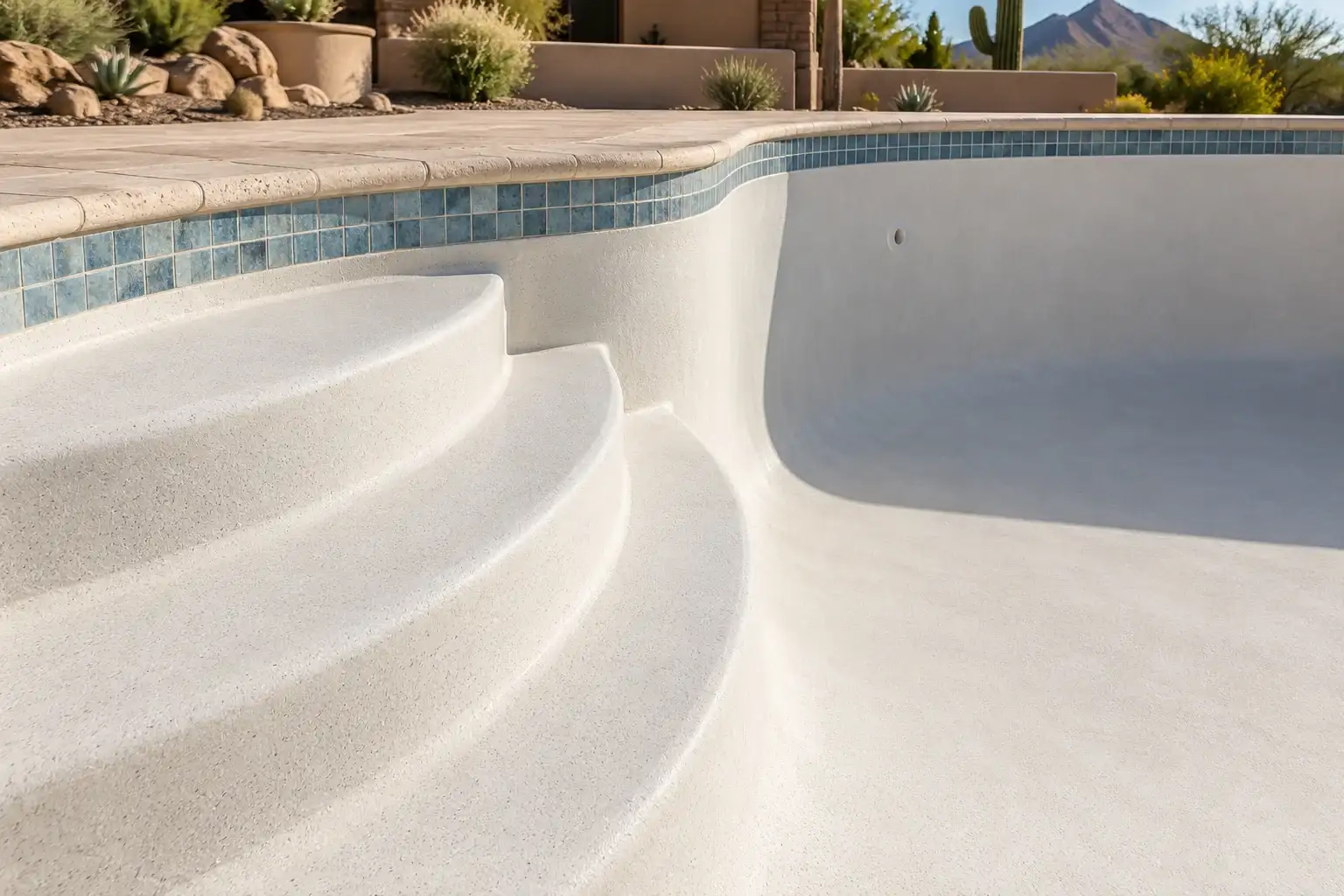
Charcoal is the quietest of the dark group. The water goes a soft blue-gray and the finish has an almost concrete quality that suits desert architecture.
Fits: a modern house with a lot of masonry, and a pool where the finish should recede behind the landscape. Skip it if: the pool is the feature and the deck is pale. Charcoal disappears next to a light deck. Arizona note: gray hides trowel shadow most completely, which matters because a hand-troweled finish is never perfectly even.
Deep green
Deep green gives the lagoon read: emerald at the edges, darker in the middle, closest to a natural pool.
Fits: a yard with heavy planting, where the water should look like it belongs to the garden. Skip it if: the pool has an algae history. Green water on a green finish makes an early bloom hard to spot. Arizona note: green hides leaf tannin and dust better than blue, but shows algae at the returns first.
Dark taupe and sand
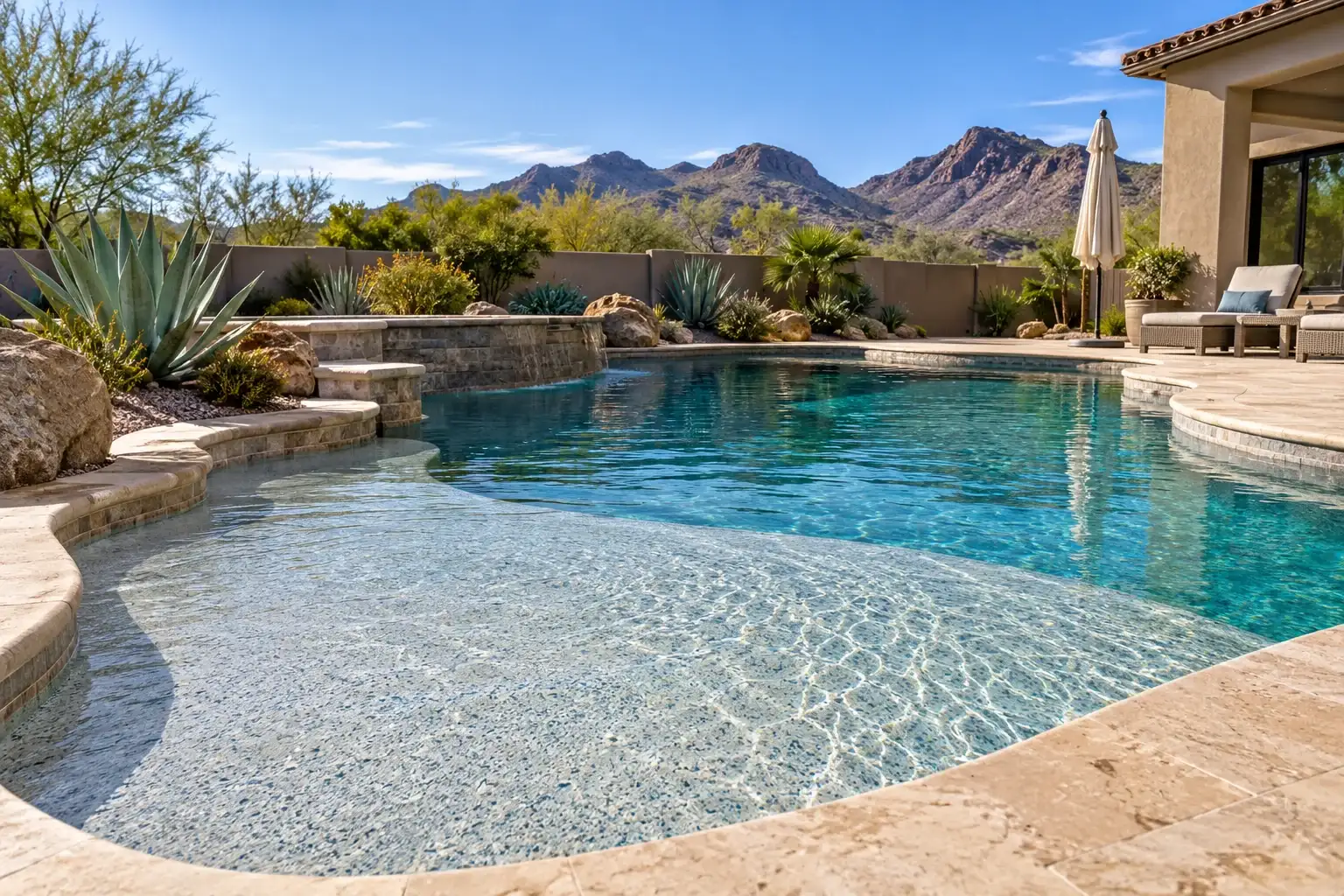
Dark taupe is the warmest and least contrasty of the six. The water reads warm stone and the finish is hard to make look dirty.
Fits: a Mediterranean or Santa Fe house, travertine decking, and anyone who wants the low-maintenance end of the dark range. Skip it if: the whole point is a dramatic water colour. Taupe gives warmth, not depth. Arizona note: taupe is the most forgiving tone against 13 to 17 grain water, because a mineral film sits close to its own colour.
Dark quartz blends
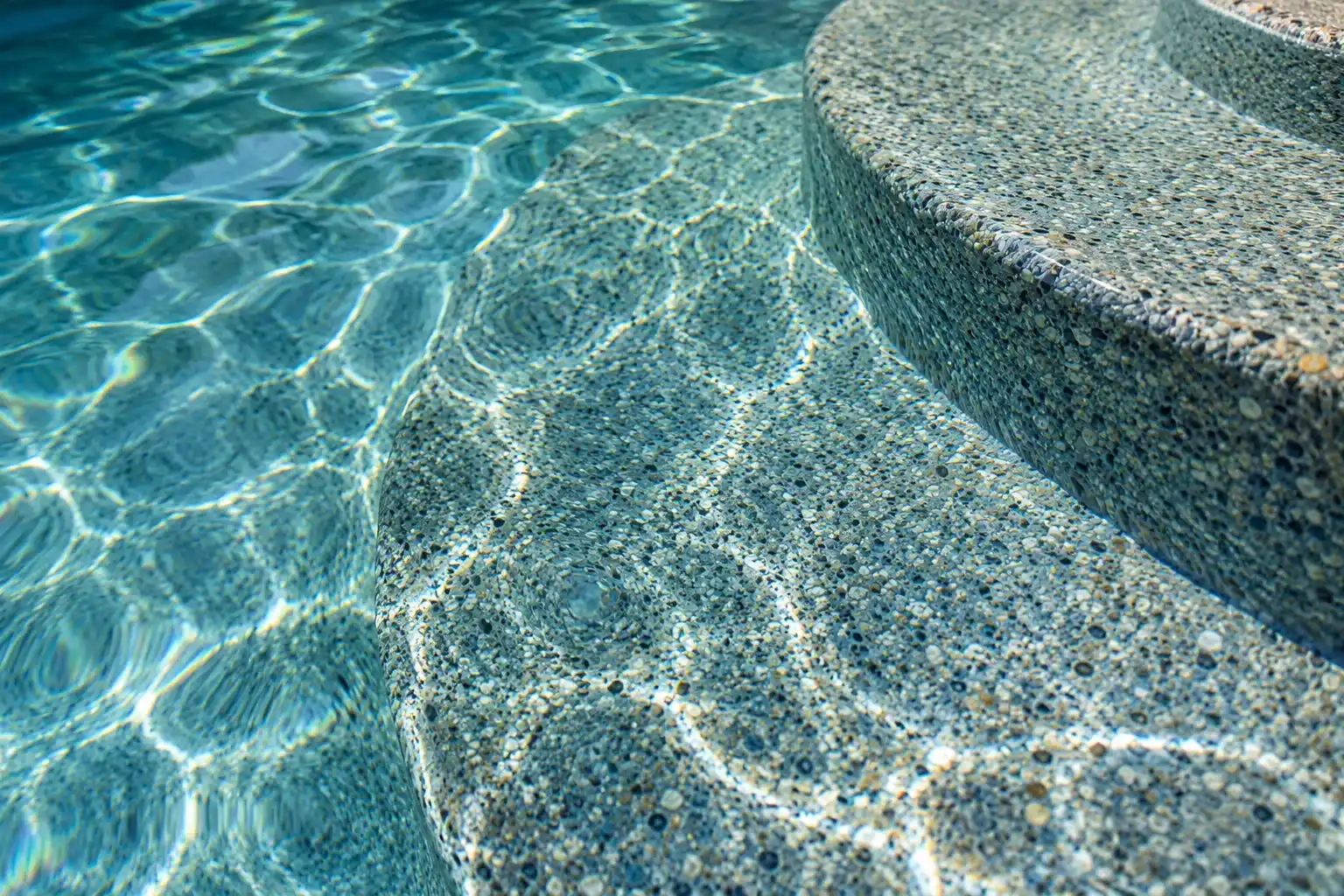
A dark quartz blend sits between plaster and pebble: ground quartz rather than stone, so the surface is smoother and the colour more even, with less of the mottled character an aggregate gives.
Fits: a pool where the finish should feel smooth underfoot and the colour should stay consistent across a large wall. Skip it if: the appeal of pebble is the texture and the depth of colour that stone gives. Quartz reads flatter. Arizona note: a smooth dark surface reflects more light and shows a mineral film more clearly than a textured one. Quartz pool finish covers how that surface is built.
Good to know
The comparison, on the same criteria
| Finish tone | Water reads as | Heat gain | What shows first | Relative cost |
|---|---|---|---|---|
| Black or onyx | Near opaque, still | Highest | Scale at the waterline | Set by the material |
| Midnight or navy | Deep saturated blue | High | Haze, then scale on steps | Set by the material |
| Charcoal or slate | Soft blue-gray | Moderate | Trowel shadow | Set by the material |
| Deep green | Lagoon green | Moderate | Algae at returns | Set by the material |
| Dark taupe or sand | Warm stone | Lowest of the group | Very little | Set by the material |
| Dark quartz blend | Flat, even colour | Moderate to high | Mineral film on smooth walls | Between plaster and pebble |
Cost tends to follow the material more than the colour, so the finish type you pick sets the price more than the tone does.
Arizona water and sun
What the water does to a dark finish
Two things happen to a dark finish in Scottsdale, and neither is a defect. The first is shade variation in the cement. The National Spa and Pool Institute and the National Plasterers Council both describe a finish as uniform in shade "subject to normal cement plaster mottling and shading", and maker literature notes mottling can appear on the first day or up to four or five months later (SGM). SGM lists unbalanced water at start-up and high pH or total alkalinity during the 28 day hydration among the possible causes. On a dark surface that variation simply has more contrast.
The second is mineral film. Scaling is the most common maintenance issue on an exposed aggregate finish, a white haze that can trap dirt and discolour the finish further (Pebble Technology International). Against black or navy that haze is a visible cloud; against taupe it reads as part of the colour. Neither tone prevents scale. The difference is how much of it you see.
How long the finish lasts covers ageing rather than appearance.
Good to know
What decides it in your pool
Four things settle the tone: how much sun the pool takes, how hard the local water is, whether the deck and house are warm or cool, and who looks after the water between visits. A full-sun pool in south Scottsdale, where the report puts hardness at 13 to 15 grains per gallon, is a different calculation from a shaded pool north of Chaparral Road. The shell matters too: a dark finish shows every patch, so a repaired shell needs a tone with texture.
A local pro looks at the shell, the sun exposure and the existing water before the colour is ordered, because a chip and a full pool often do not match. Tell us the tone you are leaning toward and we call you back to talk through what it will look like once it is full. Dark finishes, glass tile and spa spillways sets colour next to the rest of the project, and pebble pool finish covers the surface itself.
4 questions
Questions people ask
Still have a question? Call (747) 243-2089 and say what your pool is doing.
Does a black pool heat the water more?
Yes. A dark surface absorbs more of the sun's energy than a white one, so the same pool runs warmer, and Phoenix July highs average above 106 F. It matters most in a shallow pool with full sun and least in a deep, shaded one.
Can a dark finish be patched without it showing?
A patch can show because new cement may cure a slightly different shade and the texture can differ. Blending improves with time but rarely disappears, which is one reason to do the whole surface at once.
How long does a dark pebble finish hold its colour?
The stone itself tends to hold its colour, so what changes over the years is more often the surface film and the cement. Balanced water and no scale is what holds the original look.
Is a dark finish harder to keep clean?
It is not dirtier, it is more legible. Dust, leaf tannin and mineral film that a white pool hides show against a dark surface, so a dark pool rewards a steady routine.
Sources
Sources
- City of Scottsdale, 2026 Water Quality Report (opens in a new tab)
- SGM, Mottling technical document
- Pebble Technology International, Customer Support
- National Plasterers Council, Start-Up Card
- National Weather Service Phoenix, July 2026 Climate Summary (opens in a new tab)
- Pool Help, How White Pool Plaster Becomes Mottled and Gray Discolored
Last checked: November 2026