Blog · November 7, 2026 · 9 min read
Luxury Pool Resurface Ideas in Scottsdale: Dark Finishes, Glass Tile and Spa Spillways
A luxury resurface in Scottsdale is not a colour card. It is three separate specifications: the pool body, the spa, and the band where water meets air. Get those three right and the pool reads expensive from the street. Get them wrong and the most costly finish on the block looks tired after two summers. Call (747) 243-2089 or tell us what your pool is doing and the look you have in mind, and we call you back to go over the shell, the water and the finish.
Good to know
What separates a luxury resurface from a new one?
The money sits in different places. A luxury resurface spends on the surfaces a body touches and the details the eye lands on, and it spends very little on the parts of the pool nobody sees. That is the whole idea: the same budget split badly can produce a pool that photographs well on day one and reads tired by year three.
Here is the part that most Scottsdale homeowners hear for the first time on site. The spa and the spillway are not the same surface as the pool body, and they should not share its specification. A spa should be kept no hotter than 104 F (Centers for Disease Control and Prevention), which is still hotter than the pool, and a spillway runs a thin film of water over tile in open air all day. Those two conditions, heat and constant thin-film evaporation, both push minerals out of the water and onto the surface. The spa and the spillway are a small part of the visible pool, yet they are where mineral deposit tends to show first. Specifying them separately, with their own tile, their own membrane and their own grout, is a change that helps a project age well. A deep dive on that decision sits in which finishes and tiles hold up on a spa and spillway.
Arizona water and sun
Dark finishes change the water, not just the pool
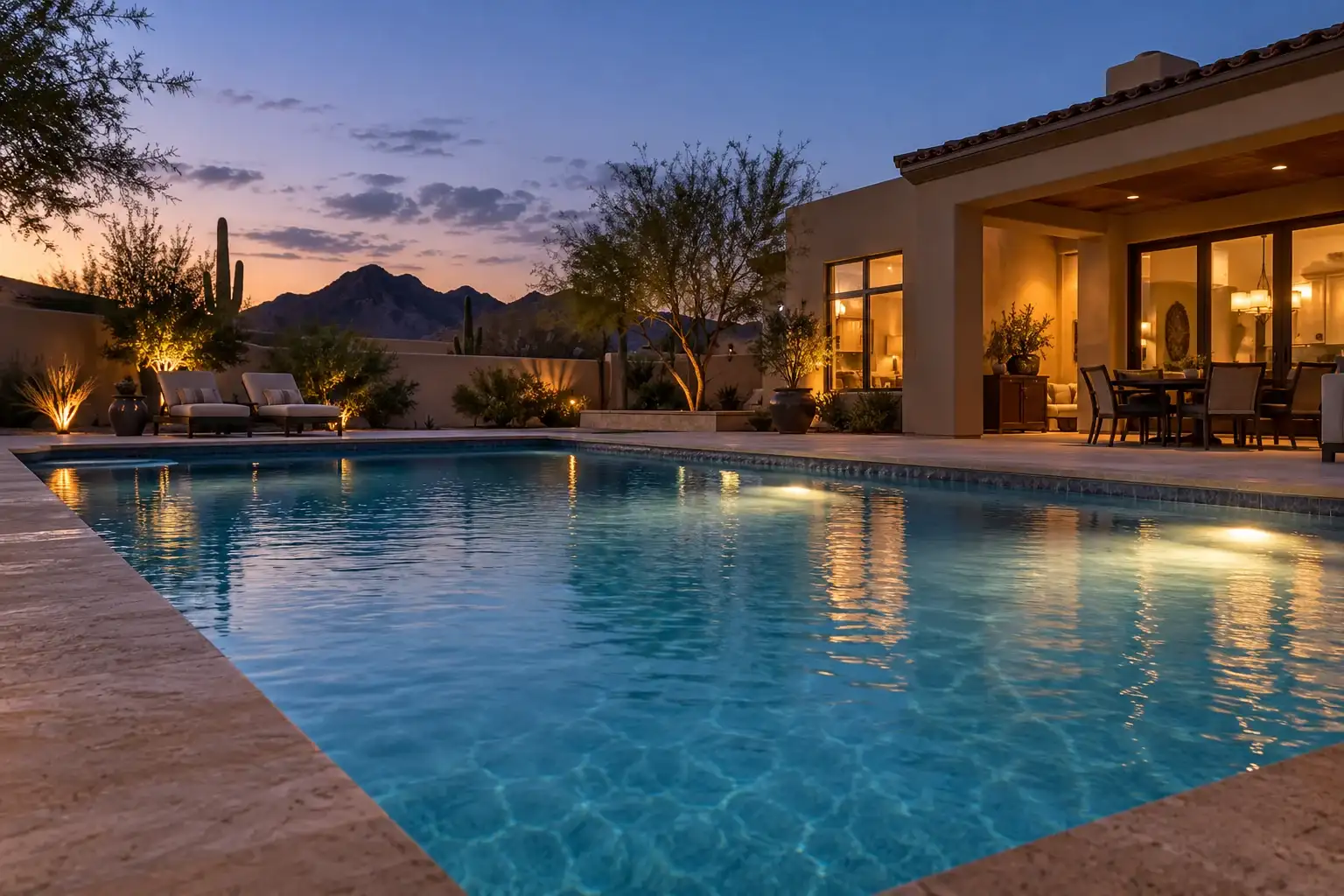
A dark pebble finish does more work than a lighter one, because it stops reflecting the sky and starts reflecting itself. A midnight blue or charcoal surface turns the water into a deep, still colour that holds the shape of the pool, which is why it photographs so well at dusk. A light plaster pool reads bright and slightly flat by comparison, and the difference is the surface, not the water chemistry.
The trade is honest. Dark surfaces absorb more of the sun's energy, so the water runs warmer in July, when Phoenix averaged a high of 108.3 F against a 106.5 F normal in July 2026 (National Weather Service Phoenix). Warmer water also holds less dissolved oxygen and grows algae faster if the chemistry slips. And a dark finish makes two things visible that a white pool hides: shade variation in the cement, and white mineral film. Both are real in Scottsdale, where water runs 13 to 17 grains per gallon depending on which band of the city the pool sits in (City of Scottsdale 2026 Water Quality Report).
| Finish tone | What the water reads as | How it takes heat | What shows first |
|---|---|---|---|
| Black or onyx | Deep and still, almost opaque | The warmest of the group | Chalky scale and any shade variation |
| Midnight or navy blue | Saturated blue, strong at dusk | Warm | Scale at the waterline and on steps |
| Charcoal or slate gray | Soft blue-gray, calm | Moderate | Trowel shadow, mild scale |
| Deep green | Lagoon green, dark at the edges | Moderate | Algae at returns and on the shelf |
| Dark taupe or sand | Warm stone, low contrast | Coolest of the dark group | Very little, which is the point |
The shade variation is not a defect. The National Spa and Pool Institute and the National Plasterers Council both describe a finish as uniform in shade "subject to normal cement plaster mottling and shading", and the maker literature is blunt that mottling can appear on day one or up to four or five months later (SGM technical document). SGM lists several possible causes, including unbalanced water at start-up and high pH or total alkalinity during the 28 day hydration. On a dark surface the same variation has more contrast, which is the only reason it gets noticed. How each dark colour heats, fades and wears goes tone by tone.
Tile and coping
Glass tile belongs where the water meets the air
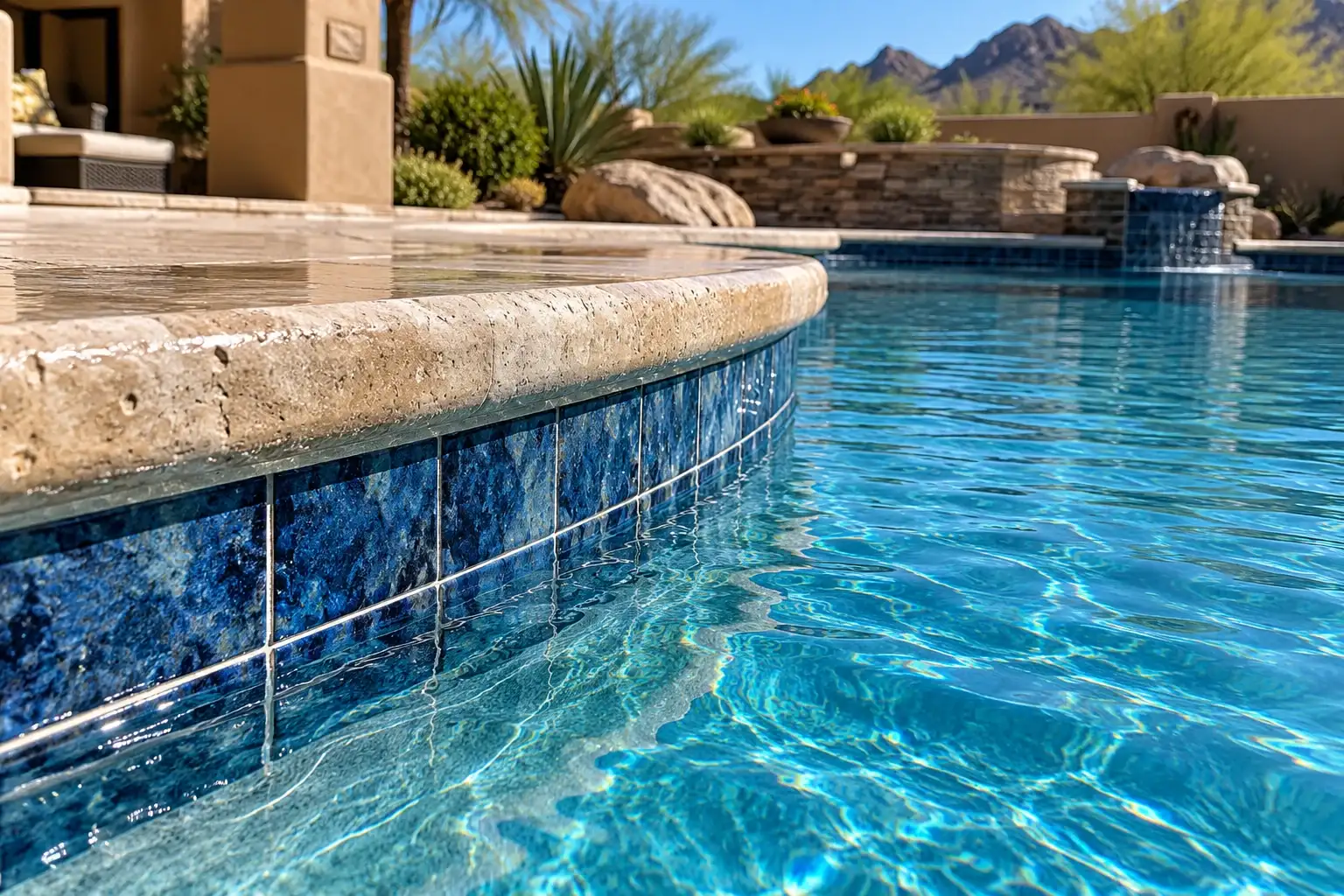
Glass mosaic earns its place on a luxury pool for one reason: it holds colour and reflectivity in the same plane, so a waterline in cobalt or sea glass reads as jewellery rather than as trim. Put it on the waterline, the spillway face, the step risers and the spa, where the eye goes. Do not put it on the whole floor. Cost scales with area, and so does the risk, because glass is a different material to install than ceramic.
The technical part matters more than the colour. Glass tile is more likely than ceramic to crack from thermal shock outdoors, and it should meet ANSI A137.2, with a setting material formulated for glass (Custom Building Products, installing tile in pools and fountains). Under it, the waterproofing has to meet ANSI A118.10 and tie into every penetration, lights, pipes and niches, and it gets flood tested before a single tile goes down. None of that is visible afterwards, which is why it is worth asking about. Pool tile replacement covers what changes when the waterline is redone with the finish.
Good to know
The spa and spillway carry their own specification
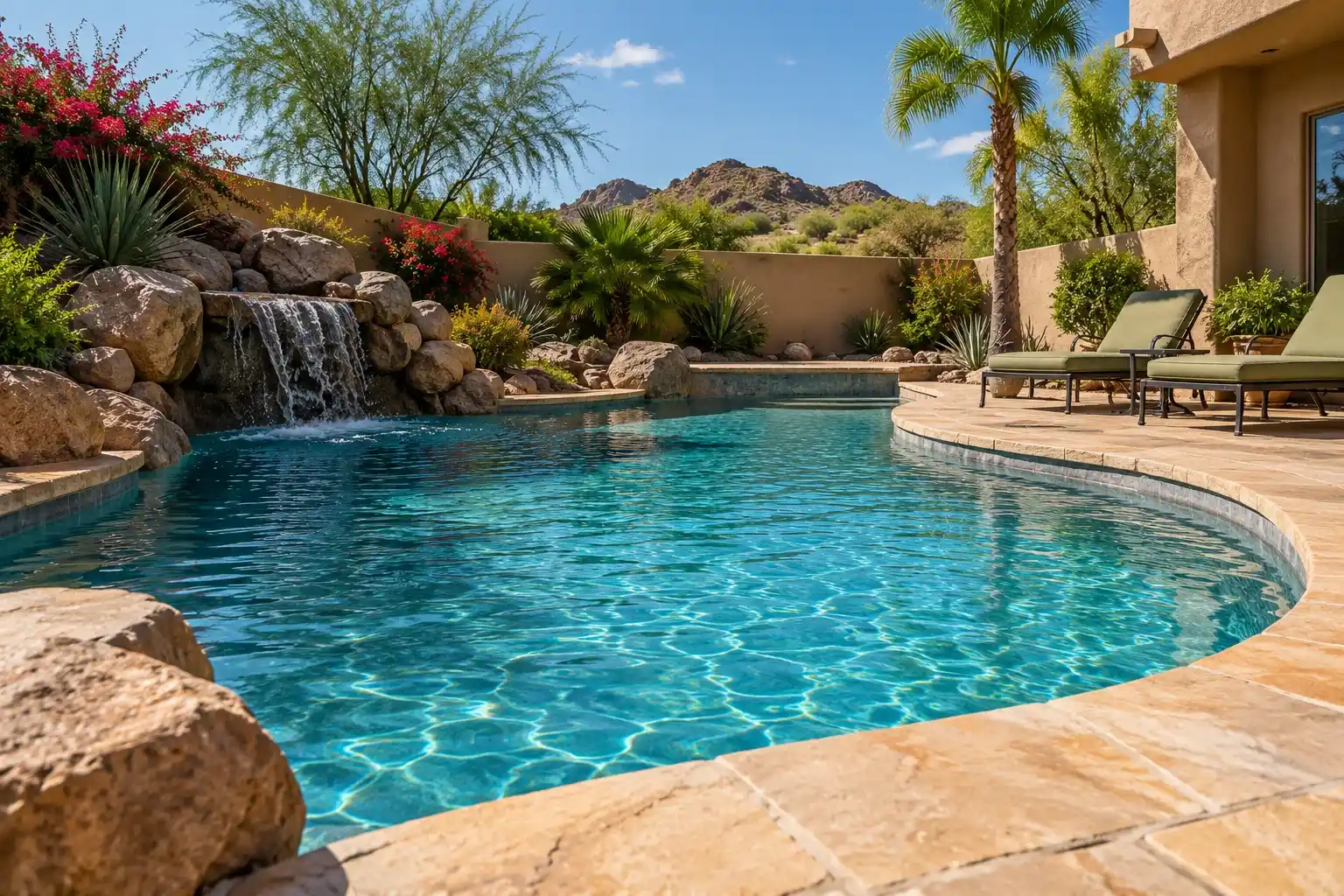
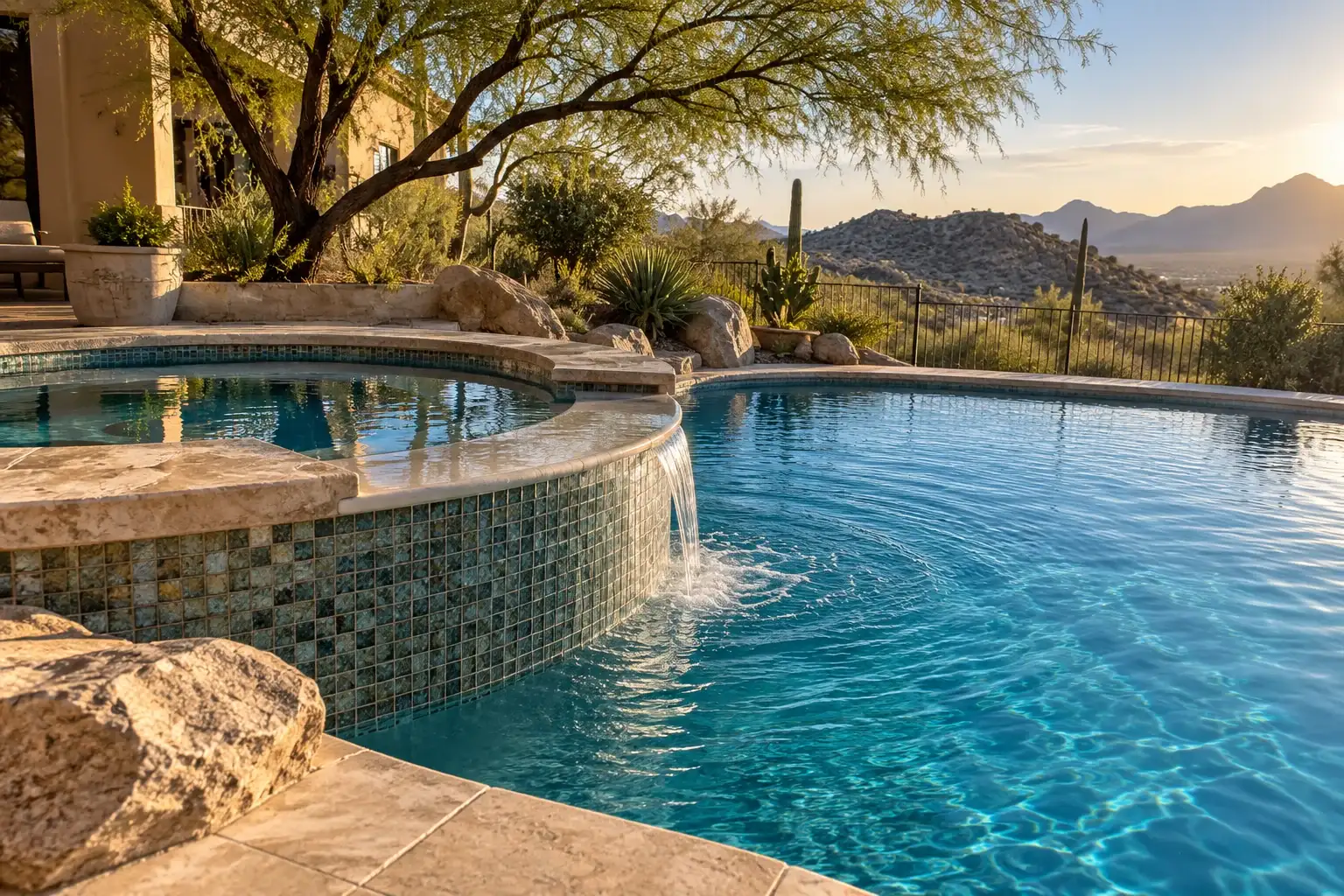
A raised spa with a spillway is the signature of a Scottsdale luxury pool, and it is also the most demanding assembly in the project. Three things make it hard. The water is hottest there, though CDC advises no more than 104 F, and warm water can scale faster. The spillway runs a film of water in open air, so evaporation can concentrate minerals at exactly the point people look at. And the shell moves differently from the deck, so the tile needs movement joints, generally every 8 to 10 ft, carried through the assembly and placed between the coping and the tile (Custom Building Products).
An exposed aggregate finish suits the spa interior because the texture is consistent and the colour runs through the stone rather than sitting on top of it. A smooth quartz or plaster spa shows every trowel pass under the light, and a spa is the one place in the pool where a body is close enough to see it. For the tile, a porcelain or glass mosaic rated for submerged use and set over a proper membrane is the combination that survives. The wrong choice is a decorative wall tile, which may not be rated for constant submersion no matter how good it looks in a showroom.
Remodeling
A shelf or a bench changes how the pool gets used
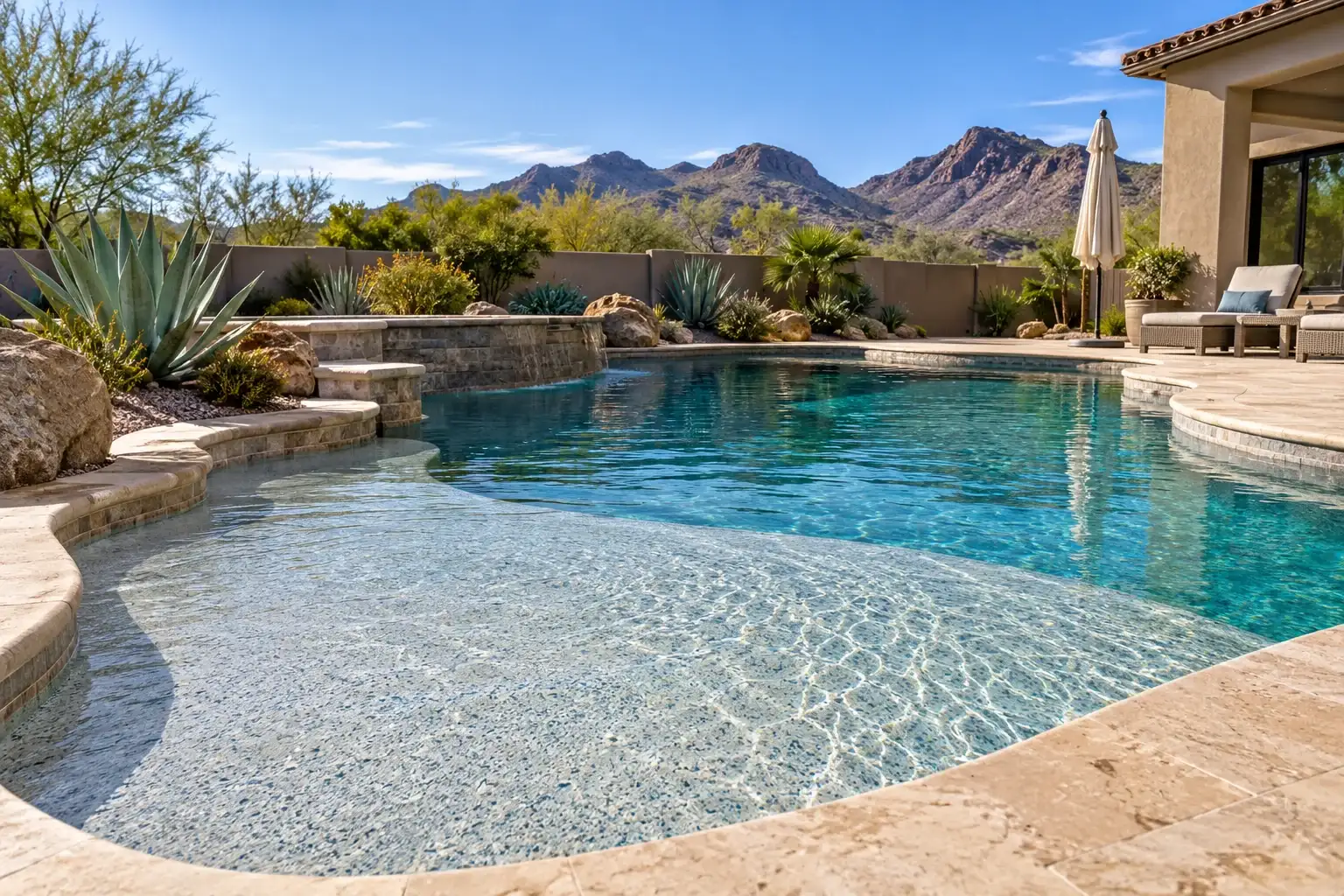
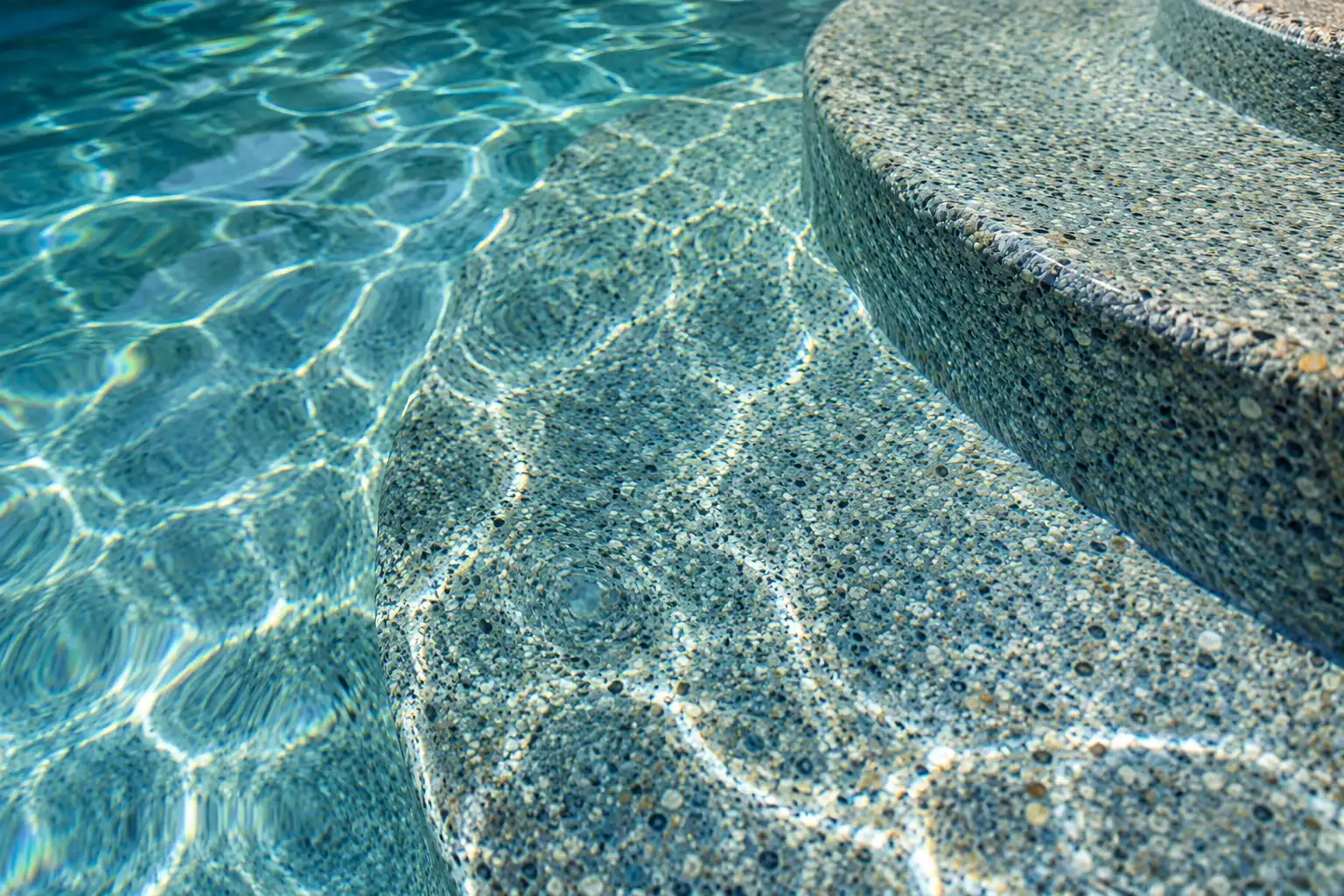
A tanning shelf is a popular luxury feature, and it changes a pool's daily life a great deal. A shelf is a large shallow area, usually beside the steps, holding a few inches of water (AQUA Magazine), which is why bubblers only make sense there. It turns the entry end into a place to sit rather than a place to wade, and on a pool with young children or grandparents it earns its cost every weekend.
On an existing pool it is a shell decision before it is a budget decision. The shelf is new concrete keyed into the shell, so a gunite pool can take one and a vinyl liner or a one-piece fiberglass shell generally cannot. Adding a shelf or bench to an existing pool walks through the depth, the circulation and what changes in the schedule.
Good to know
What the first 28 days does to an expensive finish
A finish is most vulnerable in the month after it goes on, and this is where a luxury project is won or lost. The National Plasterers Council describes a finish beginning to hydrate as soon as it is mixed, with most of that hydration inside 28 days, and names that window as the period when the surface is most susceptible to staining, scaling and discoloration. The routine in that window is not complicated: brush the whole surface at least twice a day, keep pH, carbonate alkalinity and calcium hardness tested daily for the first 14 days, adjust calcium slowly and keep it from exceeding 200 ppm, keep cyanuric acid between 30 and 50 ppm, add no salt for 28 days, and remove plaster dust with a brush vacuum around day 7.
That set of instructions is what protects a dark finish from curing into a blotchy gray. SGM lists sunlight, heat, wind and water temperature among the factors that affect mottling, so a summer start-up in Scottsdale deserves close attention. The pebble finish page covers the surface itself, and quartz pool finish covers the middle option between plaster and aggregate.
Good to know
What decides it in your pool
The shell and the water decide more than the photographs do. A gunite pool with a raised spa can carry a shelf, a glass waterline and an aggregate finish; a fiberglass shell generally cannot take the shelf, and a small pool cannot afford the shelf without losing swim lane. The band of the city the pool sits in sets the hardness, and the hardness sets how fast a dark finish will show a mineral line. Who swims, how the pool is used in July, and whether the spa runs every week settle the rest.
A local pro confirms the shell, the plumbing and the setback on site before anything is ordered. The standard setback for a pool in Scottsdale is 2 ft from the property line unless the lot carries an easement (City of Scottsdale), and that number can decide how far a raised spa or a shelf can move toward a wall. Tell us what you are planning and we call you back to go over the options in the order that makes sense for the shell. The full room-by-room scope sits in pool remodeling.
4 questions
Questions people ask
Still have a question? Call (747) 243-2089 and say what your pool is doing.
Do dark pool finishes show more dirt?
They show more of everything that contrasts. Dust and dirt settle the same way on any surface, but a white mineral film, a leaf stain and a patch of algae all read more strongly against black or navy than against white plaster. The pool is not dirtier. It is more legible, which is why dark finishes reward a steady chemistry routine.
Will a black pool be too warm in July?
It will be warmer than a white pool in the same yard, because a dark surface absorbs more of the sun's energy, and Phoenix July highs average above 106 F. Whether that is a problem depends on the pool. A shaded pool or one with a cooler running schedule is fine. A full-sun pool that is already warm in August may not want the extra heat.
Is glass tile worth it at the waterline?
It is worth it where you will see it every day, which is the waterline, the spillway and the spa. What it is not worth is a full interior, both for cost and for the installation risk. Glass has to be rated for submerged use, meet ANSI A137.2 and go over a waterproof membrane that is flood tested, so the value is in the assembly behind it as much as the tile.
How soon can the pool be used after a resurface?
It is filled quickly, but the finish hydrates mostly within its first 28 days, and that month is when it is most susceptible to staining, scaling and discoloration. The safe answer is that swimming comes back once the water is balanced and the finish has had its first weeks of brushing, and the schedule is set on site. Poor start-up water balance is one cause SGM lists for mottling.
Sources
Sources
- City of Scottsdale, 2026 Water Quality Report (opens in a new tab)
- City of Scottsdale, Swimming Pools, Hot Tubs and Spas (opens in a new tab)
- National Weather Service Phoenix, July 2026 Climate Summary (opens in a new tab)
- National Plasterers Council, Start-Up Card
- SGM, Mottling technical document
- Centers for Disease Control and Prevention, Staying Healthy in Hot Tubs (opens in a new tab)
- Custom Building Products, Installing Tile in Pools and Fountains
- AQUA Magazine, Rise of the Tanning Shelf
- Pebble Technology International, Customer Support
Last checked: November 2026