Blog · November 7, 2026 · 6 min read
Which Finishes and Tiles Hold Up on a Spa and Spillway?
On a Scottsdale pool, the spa interior wants an exposed aggregate finish and the spillway face wants a mosaic rated for constant submersion, set over a waterproof membrane with movement joints at the shell and the deck. Anything smoother inside the spa, and anything not rated for pools on the spillway, is where problems tend to start. Call (747) 243-2089 or tell us how the spa and spillway are built, and we call you back to go over which tile and finish suit that assembly.
Arizona water and sun
Why the spillway is the hardest surface in the pool
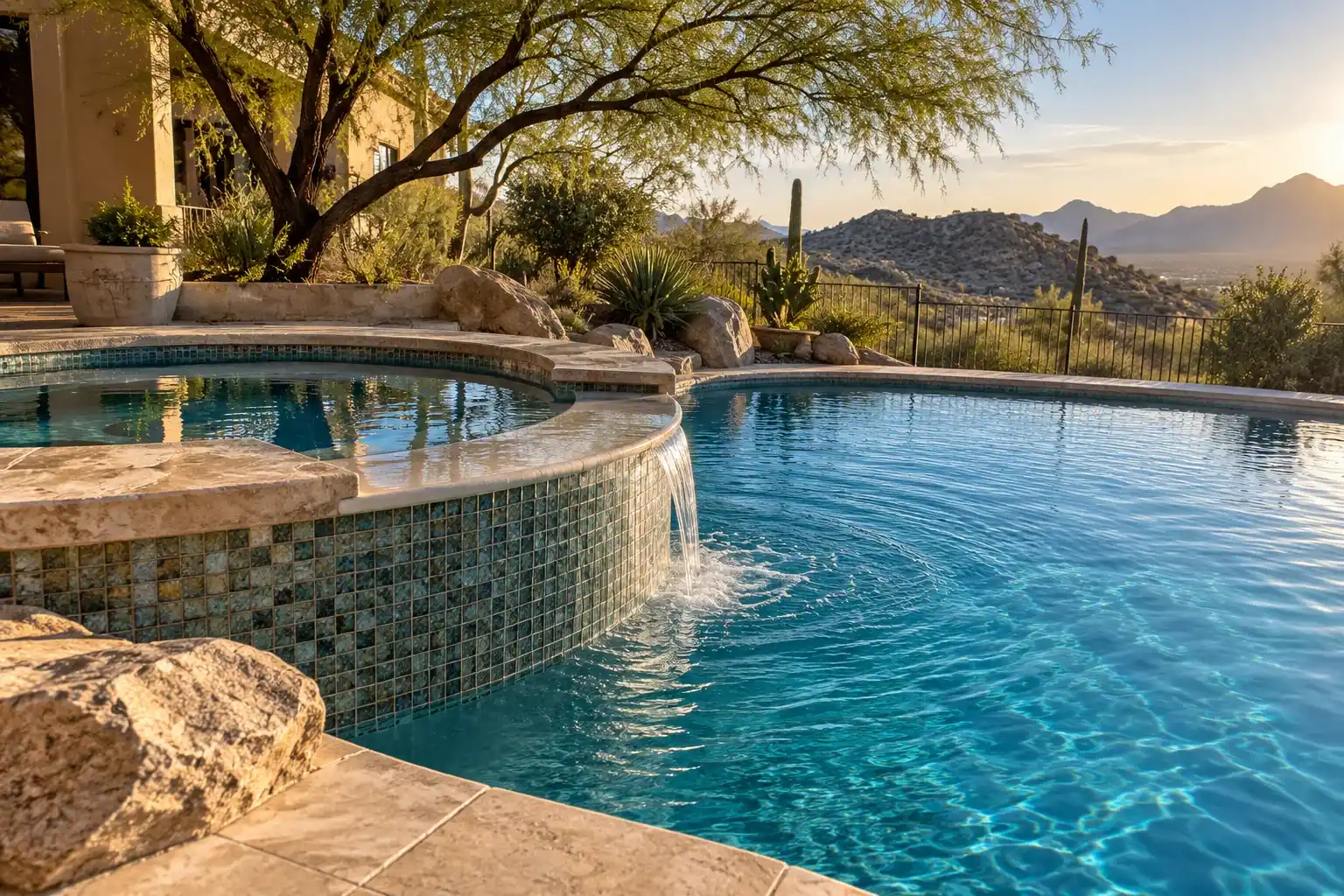
A spillway is a thin film of water running over tile in open air, all day, at the point where the pool meets the sky. That combination can concentrate minerals. Water evaporates off the film, so the calcium that was dissolved in it can stay on the tile and build in layers. The waterline below shows a line. The spillway face shows a sheet.
Heat adds to it. A spa should be kept no hotter than 104 F (Centers for Disease Control and Prevention), warmer than the pool body, and warm water can scale more readily. In Scottsdale, where the water runs 13 to 17 grains per gallon depending on the band of the city, that means a spillway can be one of the first places a homeowner notices mineral deposit.
Tile and coping
What the tile has to survive
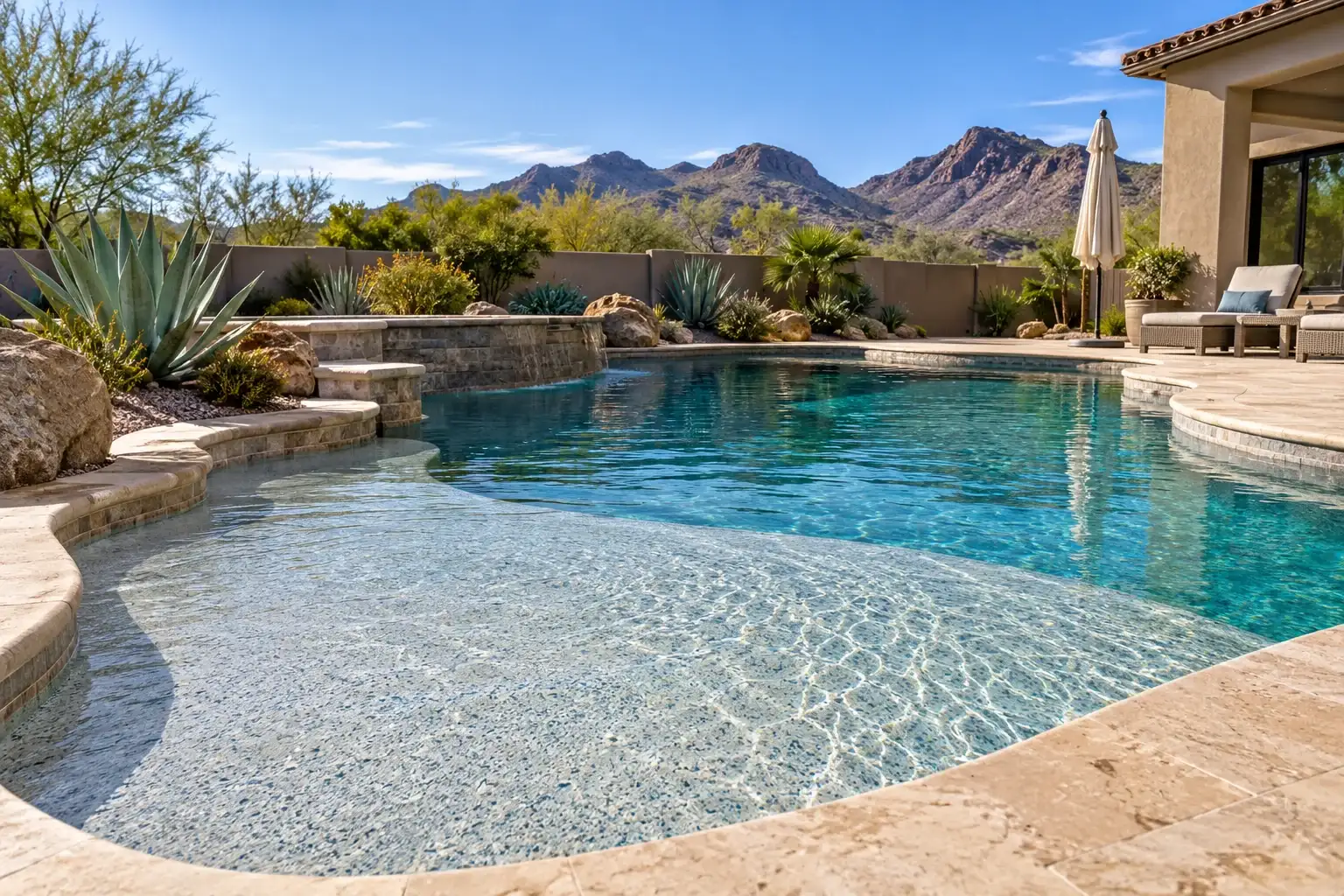
Three things, and only one of them is about looks. The first is constant submersion: not every ceramic tile is suitable for submerged applications, and the maker should recommend the tile for use in submerged applications. A decorative wall tile that is fine in a shower may not qualify.
The second is thermal shock. Glass tile is more likely than ceramic to crack from thermal shock outdoors, so it should meet ANSI A137.2 and be set with a mortar formulated for glass. The third is movement. The shell and the deck move differently, so movement joints in the concrete have to carry through the tile assembly, generally every 8 to 10 ft, with a joint between the coping and the waterline tile. Under all of it sits a waterproofing membrane that meets ANSI A118.10, tied into lights, pipes and niches, and flood tested before tile goes down (Custom Building Products, installing tile in pools and fountains).
One test worth knowing for any mosaic on a mesh backing: put a sheet in a bucket of water and check the hold the next day. If it comes off easily, it was not attached well or the adhesive is water soluble (Custom Building Products).
Pebble finish
Why the spa shell wants an aggregate
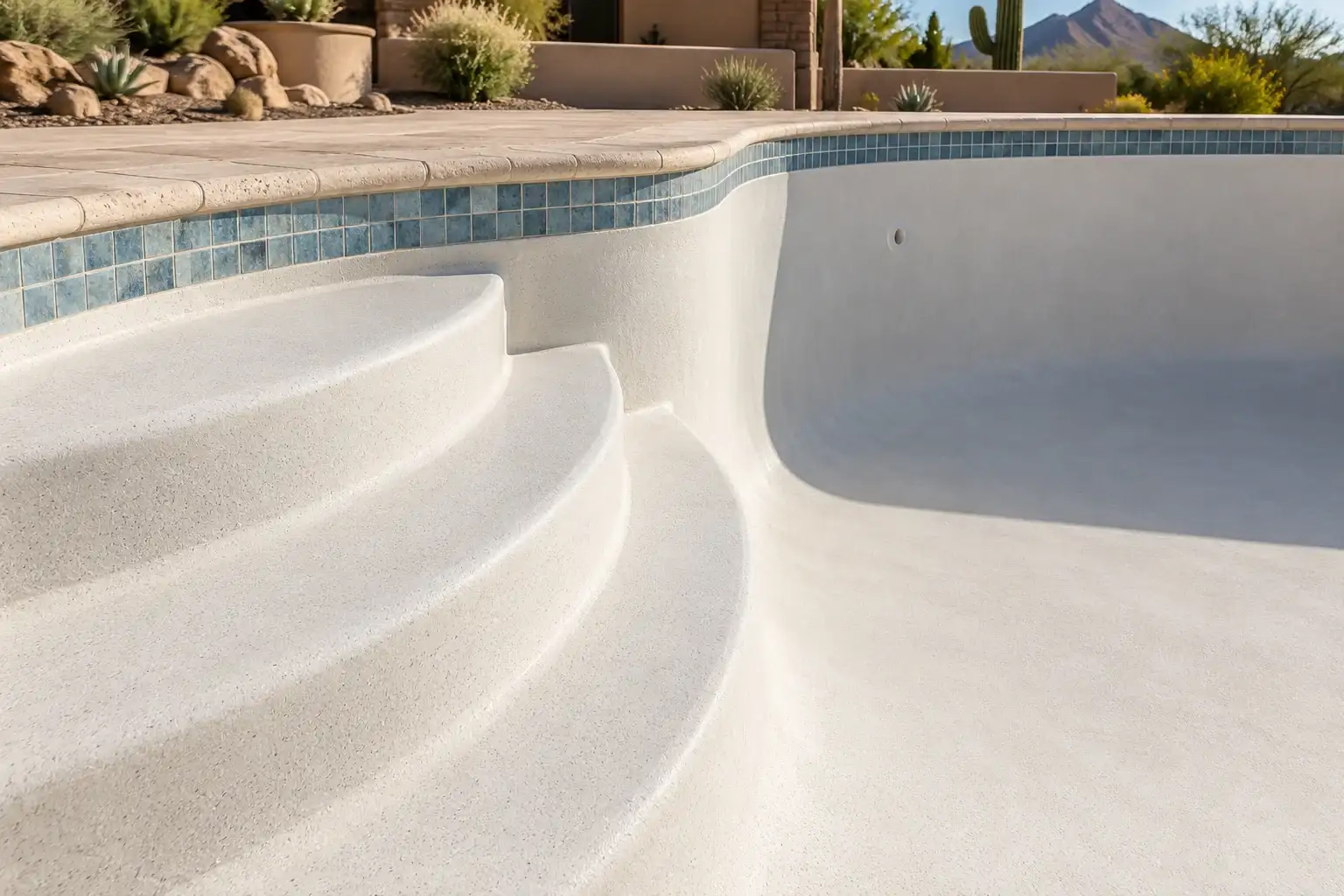
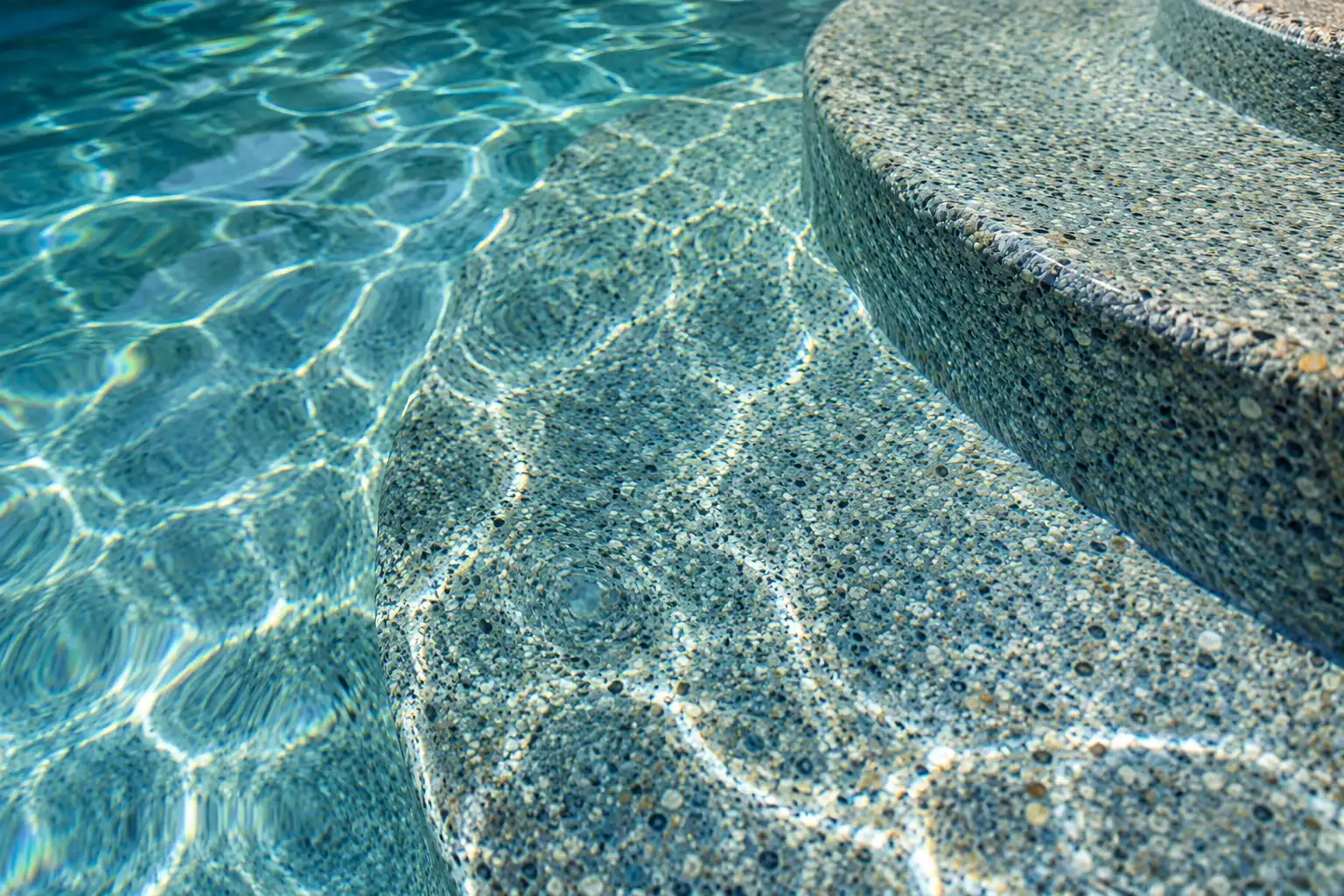
Inside the spa, an exposed aggregate finish carries the day for a simple reason: the colour comes from stone rather than from a surface coat, and the texture stays even across a curved, small, closely inspected area. A spa is the one place in the pool where a body is within arm's reach of the wall, so every trowel pass shows under the light.
A smooth quartz or plaster spa is possible and looks clean when it is new. What it does not do is hide the shade variation that a hand-troweled cement product can have. The National Spa and Pool Institute and the National Plasterers Council both describe a finish as uniform in shade "subject to normal cement plaster mottling and shading", and on a smooth surface in a small basin that variation is what the eye finds first. On an aggregate the stone breaks it up.
| Surface | What it faces | What holds up | What fails first |
|---|---|---|---|
| Spa interior | Water up to 104 F, constant circulation | Exposed aggregate in a mid or light tone | Smooth dark plaster shows trowel shadow |
| Spillway face | Thin film, air, evaporation | Glass or porcelain mosaic rated for pools | A wall tile not rated for submersion |
| Waterline band | Wet, drying, scale | Mosaic over a membrane | Tile set directly on the shell |
| Coping edge | Sun, splash, movement | Stone or cast coping with a joint | Rigid grout at the deck joint |
| Step risers | Traffic, shallow water | Aggregate with a texture | Polished surfaces that get slick |
Good to know
Grout and the joints nobody sees
Grout in a spa is not a colour decision first, it is a submersion decision. The joint has to suit constant wet service, and the color of some grout pigments can be altered by pool chemicals, so the maker should confirm the color is stable in treated water (Custom Building Products). On a spillway, grout packed solid where the assembly needs a movement joint can crack, because the assembly has nowhere to move.
The joints that matter most are the ones nobody photographs: the joint between the coping and the waterline tile, and the joint where the tile meets the deck. If those are grouted solid instead of left as a movement joint, a crack can follow as the assembly moves.
Tile and coping
Which tile to keep off a spillway
Skip anything the maker does not rate for pools, and do not assume a sealer makes an unrated tile suitable. The maker's rating is what counts.
What is left is a short list: glass mosaic that meets ANSI A137.2, porcelain mosaic rated for submerged service, and a setting system built for it.
Good to know
What decides it in your pool
The assembly decides, and the assembly is what a pro reads on site: how the spillway is built, whether the shell has a waterproof membrane under the tile, how the spa is plumbed, and whether there is a joint at the deck. Two pools with the same tile can have very different outcomes depending on what sits behind it.
The water decides the rest. A spa with 13 to 17 grain Scottsdale water and a weekly chemistry routine behaves differently from one that runs hot and gets topped up. A local pro confirms the shell, the membrane and the joints before tile is ordered. Tell us how the spa and spillway are built and we call you back to work through the options. Pool tile replacement covers what the waterline job involves, pool remodeling covers the wider scope, and luxury resurface ideas puts the spa and spillway next to the rest of the finish decisions.
4 questions
Questions people ask
Still have a question? Call (747) 243-2089 and say what your pool is doing.
Does glass tile really crack on a spillway?
It can. Glass is more likely than ceramic to crack from thermal shock outdoors, which is why the tile should meet ANSI A137.2 and be set with a glass-rated mortar. Glass installed that way over a membrane follows the installation guidance. Glass set without the right materials is the risk the guidance warns about.
How often does a spa spillway need descaling?
It depends on the water and how the spa runs, not on a calendar. The spillway is where scale appears first, so it is also where a light film can be removed easily. Once it hardens into a crust, removal is a mechanical job. Checking it regularly makes it easier to catch while it is still a light film.
Can the spa be refinished without doing the pool?
Usually not in one pass, because the spa and pool share water and often share the same finish schedule, and a spa drained while the pool runs needs its own isolation. It is possible, and it is rarely the better value. A spa finish is often done as part of a pool resurface.
What holds up at the waterline?
A mosaic rated for submerged use, set over a waterproof membrane, with a movement joint at the coping. The waterline is the band that spends its life wet and drying, so it can collect scale faster than the walls below it. Texture can hide more of it than gloss does.
Sources
Sources
- Custom Building Products, Installing Tile in Pools and Fountains
- Centers for Disease Control and Prevention, Staying Healthy in Hot Tubs (opens in a new tab)
- City of Scottsdale, 2026 Water Quality Report (opens in a new tab)
- SGM, Mottling technical document
- Pebble Technology International, Customer Support
- City of Scottsdale, Swimming Pools, Hot Tubs and Spas (opens in a new tab)
Last checked: November 2026