Blog · November 16, 2026 · 5 min read
Why Do Pool Patches Never Match in Scottsdale, AZ?
You patch a peeling spot and the pool wears a map. The patch is brighter than everything around it, it feels different underfoot, and within a season it is lifting at the edges while new patches appear next to it. None of that is bad luck. It is how patches work, and in Scottsdale the conditions that caused the first patch just work faster on the rest.
Good to know
What a patch actually is
A patch is new plaster dabbed onto old plaster. It does not bond chemically, not in any meaningful sense. It bonds mechanically: the patch material keys into a roughed-up surface and hangs on by grip. The surrounding finish is aged, chalked, and etched by years of water. The patch is fresh cement paste, brighter, denser, and full of material the old finish lost long ago. Put them side by side and the difference is not a skill problem. It is two different materials pretending to be one surface.
In Scottsdale, the pretending lasts even less time than elsewhere. The sun fades the new material fast, the hard water starts working on the seam, and the summer evaporation stresses the boundary between old and new. What starts as a subtle color difference becomes an outline by the end of the first season.
The map shows up for three reasons, and every one of them is structural. The color is different. The texture is different. And the old finish around the patch keeps failing, because it was already failing when the patch went on. A patch fixes a spot. It does not fix what made the spot.
Good to know
Why the color never matches
Old plaster is not the color it was when it was poured. Water chemistry etches the surface, sun fades it, and hard water scale works into it. A Scottsdale finish that has lived through a few summers is whiter in some places, yellower in others, and chalky across the whole surface. The patch is factory fresh, the exact color the old plaster was on day one. Against a ten-year-old surface, that color does not exist anywhere in the pool except inside the patch.
The sun makes the mismatch permanent in both directions. The patch fades as it ages, chasing the color of the surrounding finish it will never quite reach, while the surrounding finish keeps fading further away. On a west-facing Scottsdale pool, where the afternoon sun lands on the shallow end all summer, the contrast only grows. You can tint a patch mix, and a good crew will try, but the result is an approximation of a moving target.
Scale adds its own layer to the problem. The surrounding finish carries years of hard water mineral in its surface, and the patch has none yet. The patch stays bright while the rest of the pool slowly grays. In a town where every pool lives under the same sun and the same fill water, that difference is baked in from day one.
Good to know
Why the texture never matches
A patch is troweled by hand into a hole in a surface that was troweled by a different hand in a different decade. The old finish has been brushed, etched, and sun-dried, so its texture is a record of its age. The patch is new and dense. Even under a perfect color match, the feel gives it away, and the eye finds it in the light.
Then there is the interface, the seam where the patch meets the old finish. That seam is the weak point of every patch, because it is where the new material's grip runs out. Water finds the seam first, works into it, and the patch begins to lift from the edges inward. The moisture and blistering pattern is the same failure the shell sees when a finish goes over a damp prep: trapped water, no bond, and a visible boundary.
Signs
Why the surrounding finish keeps failing
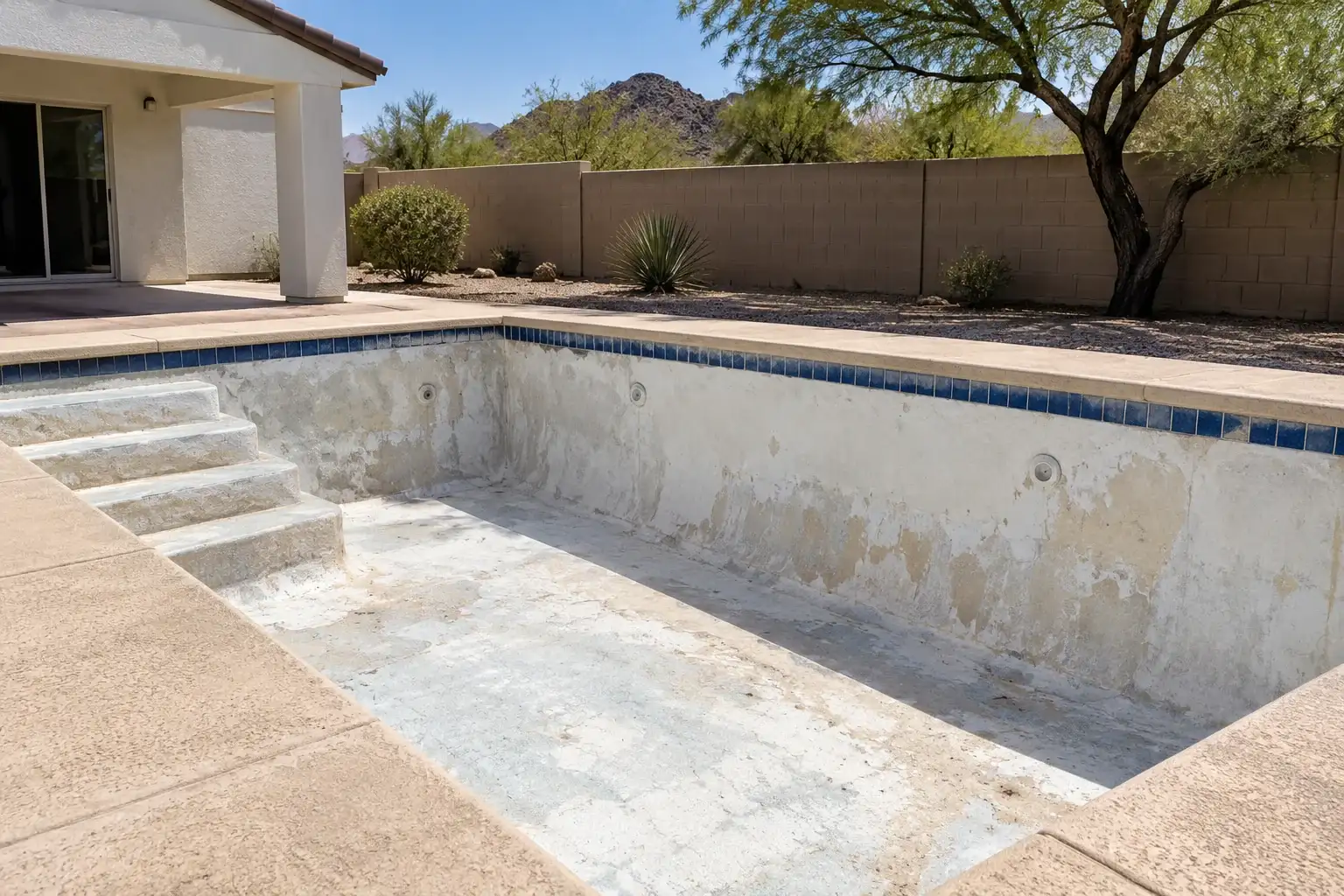
The patch does not stop the aging process that made the original spot. The finish around it is the same age, the same chemistry, and the same sun exposure. It chalking is what made the first spot peel, the rest of the pool is chalking too, just a season behind. So the owner patches again, and then again, and the pool becomes a quilt. The acid wash conversation happens somewhere in that sequence, and it buys time the same way, by spending what is left of the surface.
Scottsdale accelerates the whole loop. Hard water keeps the chemistry aggressive, the sun keeps the surface aging faster than the national average, and the summer evaporation keeps the waterline stressed. A patch that would hold up for years in a mild climate is a temporary repair here, and the surrounding finish is already scheduled for more of them.
Good to know
When a patch is the right call
A patch makes sense when the damage is small and the surrounding finish is sound. A spot the size of a dinner plate, caused by a dropped object or a localized scrape, patched into a finish that is otherwise tight: that is a repair that can last. The finish around it is not failing, so the patch only has to match, not to hold back a tide.
The test is the walls. Run a hand over the finish away from the spot. If it is smooth and firm, patch the spot. If it is rough, chalky, or shedding powder, the spot is not the problem. The surface is, and the patches are just the first visible chapter of it.
Good to know
When the map is the diagnosis
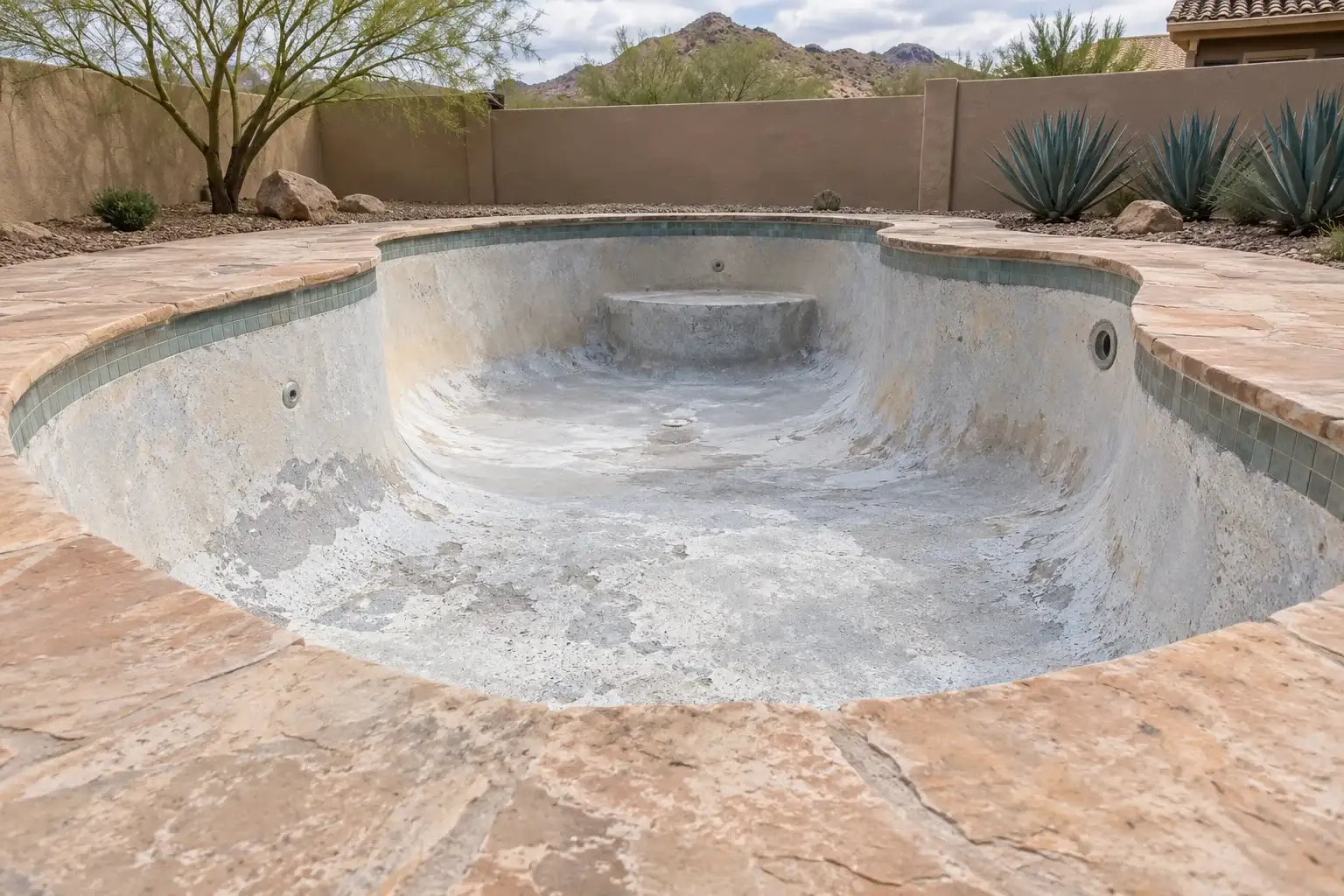
A pool with multiple patches, patches that lift, and a finish that chalks is a pool that has already told you the answer. The resurfacing is coming. The question is whether it happens now, with one drain and one prep, or later, after another summer of patches that each cost real money and buy nothing.
The economics are quiet but clear. Patches are cheap individually and expensive in sequence, and they do not delay the resurface by much. In a town where the sun and the hard water are doing the same work on the rest of the finish, the honest comparison is patch work versus the full resurfacing scope, priced over the next few summers rather than over this month.
Costs
What it costs and what drives the number
A single patch into a sound finish is a small job. Patches into a failing finish add up into a budget line that nobody planned, and each one makes the eventual resurface no cheaper. The resurfacing itself is driven by the usual Scottsdale drivers: surface area, finish choice, prep method, and the tile and coping that ride along. The cost calculator stacks those drivers so the endgame number is visible before another patch gets cut.
The sequence matters because the money compounds. A patch here, a patch there, an acid wash, another patch, and suddenly the total spent approaches a meaningful share of the resurface that would have ended it all. None of it moved the finish's deadline. It just stretched the payments out and kept the pool looking patched. If the quilt has grown, the next dollar belongs to the fix, not to another square.
If the pool is at the quilt stage, the timing question matters too. There is a right season to drain and resurface in Scottsdale, and a wrong one, and the wrong one has monsoon ground water and summer heat attached to it.
Good to know